
Medical Disclaimer: This resource is for general educational and organizational purposes only and is not a diagnostic tool or a substitute for professional medical advice, diagnosis, or treatment.
Living with sciatic nerve pain can sometimes make it difficult to remember exactly how your symptoms have changed from one day to the next.
Maybe sitting was especially uncomfortable yesterday, but walking felt easier. Perhaps the pain that was mostly in your buttock has started traveling farther down your leg. Or you may notice that tingling comes and goes depending on your activities.
That’s where a sciatica symptom tracker can be useful.
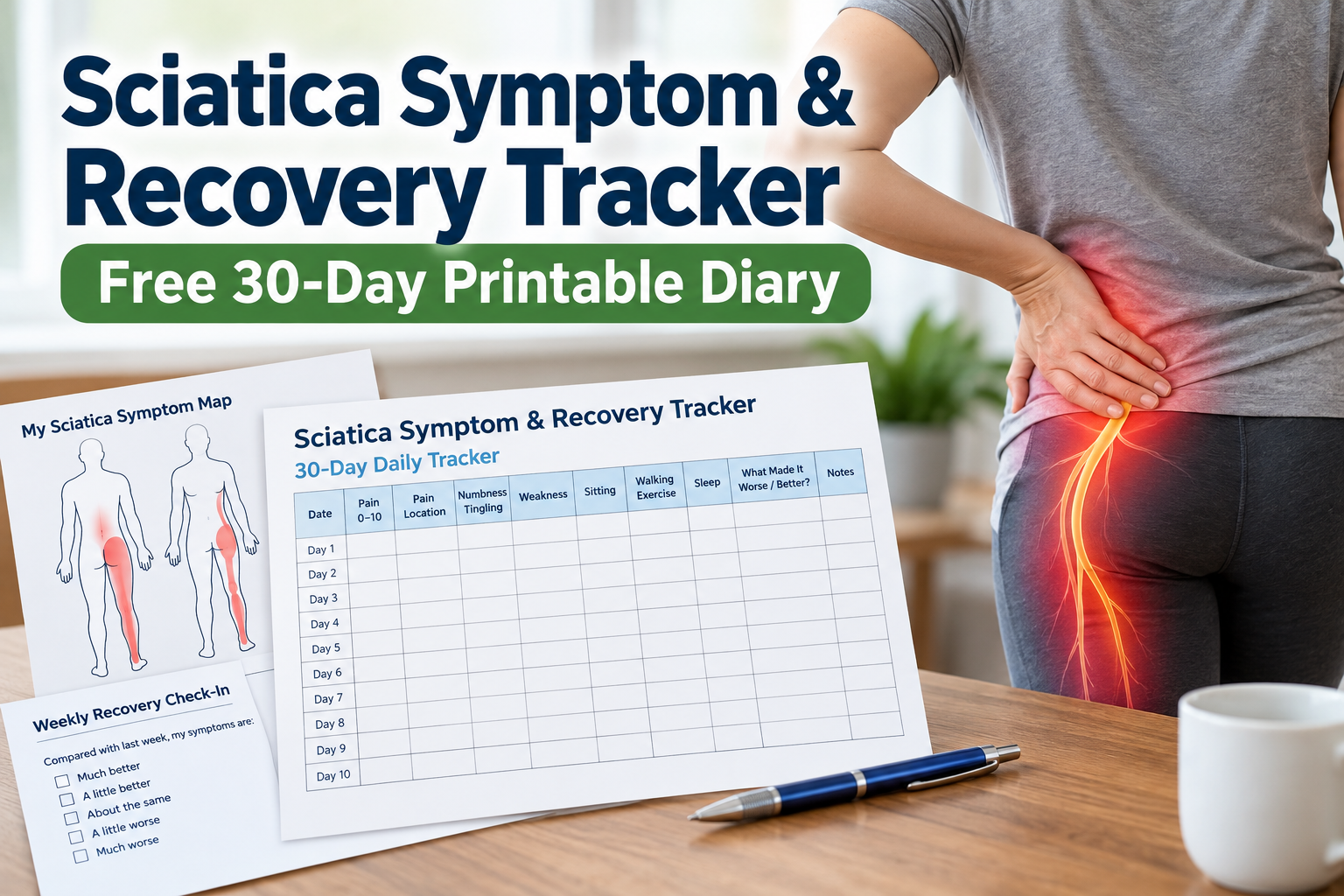
The free Sciatica Symptom & Recovery Tracker below gives you one place to record your symptoms for 30 days, including pain intensity, pain location, numbness or tingling, weakness, sitting, walking, exercise, sleep, and activities that seem to affect how you feel.
The goal isn’t to diagnose what’s causing your symptoms. Instead, it’s to help you create a simple record of your experience so you can notice changes over time and have clearer information available if you discuss your symptoms with a healthcare professional.
Quick Answer: What Is A Sciatica Symptom Tracker?
A sciatica symptom tracker is a simple diary for recording how sciatic nerve pain and related symptoms change over time. You can use this free 30-day tracker to record pain intensity and location, numbness or tingling, weakness, sleep, sitting, walking, exercise, and activities that seem to make your symptoms better or worse.
Tracking these details may make it easier to recognize patterns and remember how your symptoms have changed. However, a symptom tracker cannot determine the cause of sciatica or replace an evaluation by a qualified healthcare professional.
Key Takeaways
What does it track? Pain intensity and location, numbness or tingling, weakness, sitting, walking or exercise, sleep, and activities that may affect your symptoms.
How long should I use it? This sciatica symptom tracker is designed to provide a simple 30-day record, with weekly check-ins along the way.
What should I look for? Look for overall changes and patterns rather than focusing too heavily on a single good or difficult day.
How can it help? Your diary can help you remember symptom patterns and organize information you may want to discuss with a qualified healthcare professional.
Download The Free Sciatica Symptom & Recovery Tracker
The printable version gives you a complete 30-day sciatica symptom and recovery diary that you can keep at home or bring with you to a healthcare appointment.
It includes:
- 30-day daily symptom tracker
- Pain intensity tracking
- Pain location and side
- Numbness and tingling tracking
- Weakness tracking
- Sitting and walking changes
- Exercise/activity notes
- Sleep tracking
- Things that seemed to make symptoms worse or better
- Sciatica symptom map
- Activity pattern worksheet
- Weekly recovery check-ins
- 30-day summary
- Notes for your healthcare professional
Download Free Printable PDF
[DOWNLOAD FREE SCIATICA SYMPTOM & RECOVERY TRACKER]
The PDF can be printed and completed by hand. No account or sign-up is required.
How To Use Your Sciatica Symptom Tracker
You don’t need to record every movement or sensation throughout the day.
The purpose is to create a useful overview without making symptom tracking take over your day.
Try completing one row at approximately the same time each day.
For example, you might fill it out in the evening and think about how your symptoms behaved during the day.
Record:
Pain level: Give your overall pain a number from 0 to 10.
Pain location: Note where you felt symptoms, such as your lower back, buttock, thigh, calf, foot, or toes.
Side: Record whether symptoms occurred on the left, right, or both sides.
Numbness or tingling: Note whether these sensations were absent, mild, moderate, or strong.
Weakness: Record any weakness you noticed rather than trying to test your own strength.
Sitting: Did sitting seem easier, about the same, or harder?
Walking or exercise: Note how walking and your normal activity affected your symptoms.
Sleep: Record whether symptoms appeared to interfere with your sleep.
Better or worse: Write down anything that seemed to make your symptoms more or less noticeable.
You don’t have to complete every field perfectly.
Consistency is more useful than creating an extremely detailed diary that becomes difficult to maintain.
Simple Rating Guide
You can use these abbreviations when completing the printable tracker.
Pain
0: No pain
1–3: Mild
4–6: Moderate
7–10: Severe
Remember that pain ratings are personal. A 5 for one person does not necessarily represent the same experience as a 5 for someone else.
The useful comparison is generally your rating today compared with your own ratings on other days.
Numbness Or Tingling
0: None
1: Mild
2: Moderate
3: Strong
Weakness
N: No weakness noticed
Y: Weakness noticed
If you experience new or worsening weakness, don’t rely on the tracker alone. Contact a healthcare professional for appropriate guidance.
Daily Activities
Use:
B: Better
S: Same
W: Worse
You can also add a short note whenever those choices don’t adequately describe what happened.
Use The Sciatica Symptom Map
Sciatica doesn’t always remain in exactly the same place.
Your printable tracker includes a simple symptom map where you can record whether you notice symptoms in your:
- Lower back
- Buttock
- Thigh
- Calf
- Foot
- Toes
You can also mark whether symptoms are on the left, right, or both sides.
Use these abbreviations:
P = Pain
T = Tingling
N = Numbness
W = Weakness
For example:
Right calf — P + T
could remind you that you noticed pain and tingling in your right calf that day.
You don’t need to interpret what the location means medically. The purpose is simply to record what you’re experiencing.
Track Everyday Activities That Affect Your Symptoms
Daily activities can provide useful context.
The tracker includes space for activities such as:
- Sitting
- Standing
- Walking
- Driving
- Bending
- Lifting
- Stairs
- Housework
- Exercise
- Getting out of bed
For each one, you can indicate whether your symptoms generally seemed:
Better, About the same, or Worse
You might discover, for example, that prolonged sitting frequently corresponds with more noticeable symptoms while short periods of walking seem more comfortable.
That doesn’t necessarily tell you why the pattern occurs or mean that the same activity will affect another person similarly. It simply gives you a record of your own experience.
Complete A Weekly Recovery Check-In
Sciatica symptoms can fluctuate.
One good day doesn’t necessarily mean everything has resolved, and one difficult day doesn’t necessarily mean you’re getting worse overall.
That’s why the tracker includes a weekly check-in.
At the end of each week, ask yourself:
Compared with last week, are my symptoms:
- Much better?
- A little better?
- About the same?
- A little worse?
- Much worse?
Then consider several practical areas.
- Is sitting becoming easier?
- Is walking easier?
- Has your sleep changed?
- Is numbness or tingling changing?
- Have you noticed weakness?
- What activity was most difficult this week?
- What seemed to help?
- What seemed to make symptoms more noticeable?
This broader view can sometimes be more useful than comparing individual days.
Complete Your 30-Day Sciatica Recovery Summary
At the end of 30 days, review your diary.
Don’t simply compare your pain score from Day 1 with Day 30.
Look at the bigger picture.
Ask yourself:
- Has my pain location changed?
- Are symptoms traveling farther down my leg or staying in a smaller area?
- Has numbness or tingling changed?
- Have I noticed weakness?
- Is sitting easier?
- Can I walk more comfortably?
- Am I sleeping better?
- Which activities consistently seem difficult?
- Which activities or strategies seemed helpful?
The final page of the printable tracker gives you space to summarize these observations.
Copy-And-Paste Sciatica Symptom Tracker
Don’t want to print the PDF?
You can copy the table below into Google Docs, Microsoft Word, Apple Notes, or another document and create your own digital sciatica pain diary.
| Date | Pain 0–10 | Pain Location | Side | Numbness / Tingling | Weakness | Sitting | Walking / Exercise | Sleep | What Made It Worse / Better? | Notes |
|---|---|---|---|---|---|---|---|---|---|---|
| Day 1 | ||||||||||
| Day 2 | ||||||||||
| Day 3 | ||||||||||
| Day 4 | ||||||||||
| Day 5 | ||||||||||
| Day 6 | ||||||||||
| Day 7 |
Tip: Copy the seven rows four times to create a complete 28-day diary, then add Days 29 and 30.
Weekly Sciatica Recovery Check-In
Copy this section at the end of each week:
Compared with last week:
□ Much better □ A little better □ About the same □ A little worse □ Much worse
Average pain this week: ____ / 10
Numbness or tingling: □ Better □ Same □ Worse
Weakness: □ None noticed □ Better □ Same □ Worse
Sitting: □ Easier □ Same □ Harder
Walking: □ Easier □ Same □ Harder
Sleeping: □ Easier □ Same □ Harder
Most difficult activity:
____________________________________________
What seemed to help most:
____________________________________________
What seemed to make symptoms worse:
____________________________________________
Question for my healthcare professional:
____________________________________________
Using Your Sciatica Diary At A Healthcare Appointment
If you decide to discuss your symptoms with a healthcare professional, consider bringing your tracker with you.
Rather than trying to remember several weeks of symptoms during an appointment, you’ll have a written record showing things such as:
- When you started tracking
- Where you experienced symptoms
- Whether symptoms were mainly on one side
- How your pain changed
- Whether you experienced numbness or tingling
- Whether you noticed weakness
- Activities that appeared to affect symptoms
- Changes in sitting, walking, and sleep
- Questions you’ve written down along the way
Your healthcare professional can determine which information is medically relevant.
The diary itself does not establish the cause of your symptoms.
Don’t Let Tracking Take Over Your Day
There’s an important balance with symptom tracking. The purpose isn’t to constantly monitor your body or analyze every sensation.
A simple entry once per day may be enough. Record the information, then get on with your day.
After several days or weeks, you can look back at the diary and see whether any broader patterns stand out. The tracker should be a practical organizational tool—not another source of worry.
When Not To Wait For Your 30-Day Tracker
You don’t need to finish all 30 days before seeking medical advice.
Contact a qualified healthcare professional if your symptoms are persistent, worsening, affecting normal activities, or otherwise concerning to you.
Some symptoms deserve more urgent medical attention.
In particular, seek immediate medical care for symptoms such as new bowel or bladder control problems, numbness around the groin or saddle area, or serious neurological symptoms, especially when symptoms are sudden or rapidly worsening.
New or worsening leg weakness or significant numbness should also be medically evaluated rather than simply recorded and watched for the remainder of the 30 days.
If you’re unsure how urgently your symptoms should be evaluated, contact an appropriate healthcare professional or medical service for guidance.
Final Thoughts On Sciatica Symptom & Recovery Tracker
Sciatica can feel different from one day to another, which can make it surprisingly difficult to remember how your symptoms have changed over several weeks.
A sciatica symptom tracker gives you a simple way to create a clearer record.
You can track where you feel pain, how intense it feels, whether you notice numbness or tingling, how everyday activities affect you, and whether sitting, walking, sleeping, and normal daily activities are becoming easier or more difficult.
After 30 days, you’ll have something more useful than trying to remember how you felt several weeks ago.
Most importantly, use the tracker for what it is designed to be: a practical diary for recording your experience—not a tool for diagnosing yourself.
Download Your Free Tracker
[DOWNLOAD FREE SCIATICA SYMPTOM & RECOVERY TRACKER PDF]
Print a copy, write down your starting point, and begin with Day 1.
Medical Disclaimer: This Sciatica Symptom & Recovery Tracker is provided for general educational and organizational purposes only. It is not intended to diagnose sciatica or any other medical condition and does not replace professional medical advice, diagnosis, or treatment. If you have new, severe, worsening, or concerning symptoms, contact a qualified healthcare professional.
Explore more tools: