What Pillow Helps Sciatica? Best Sleep Positions And Pillow Tips For Pain Relief
When sciatica follows you into bed, getting comfortable can feel almost impossible. You lie on one side, and your hip starts aching. You roll onto your back and feel pulling through your buttock or leg. After another restless night, you may start wondering, what pillow helps sciatica and whether changing your sleep setup could finally give you some relief.
A pillow won’t cure a herniated disc, spinal stenosis, or another underlying cause of sciatica. But the right pillow placement can make a meaningful difference in comfort by supporting your legs, hips, and spine and reducing positions that aggravate symptoms.
You may not even need an expensive specialty pillow. A regular bed pillow placed between your knees or beneath them may be enough.
Below, we’ll look at which pillows work best for different sleeping positions, how to use them correctly, and what else you can do before bed to make nighttime sciatica easier to manage.
😴 Quick Answer: What Pillow Helps Sciatica?
The most helpful pillow depends on how you sleep. Side sleepers often benefit from a firm pillow between the knees, while back sleepers may feel better with a pillow or wedge beneath the knees. These positions can reduce twisting through the hips and help you maintain a comfortable spinal position.
There isn’t one medically proven “sciatica pillow” that works for everyone. Comfort, proper positioning, and symptom response matter more than the brand or price.
Key Takeaways
Most likely cause: Nighttime sciatica discomfort may increase when your sleeping position places your lower back, hips, or irritated nerve in a position that aggravates symptoms.
Usually serious? Usually not, but severe nighttime pain accompanied by new weakness, increasing numbness, or other neurological changes deserves medical evaluation.
First thing to check: If you’re wondering what pillow helps sciatica, start by identifying whether you’re most comfortable sleeping on your side or back and place support around your legs accordingly.
Best solution: Use a pillow between your knees when side sleeping or under your knees when sleeping on your back, then adjust thickness until your body feels comfortably supported rather than forced into position.
🧠 Why Sciatica Can Feel Worse At Night
Sciatica involves irritation or compression of nerve roots in the lower spine that contribute to the sciatic nerve.
Depending on the underlying problem, symptoms may include:
- Shooting pain from the buttock into the leg
- Burning sensations
- Tingling or pins and needles
- Numbness
- Lower-back discomfort
- Leg or foot weakness
Nighttime can make these symptoms particularly frustrating.
During the day, you naturally change positions. You walk, stand, sit, bend, and shift your weight. In bed, you may remain in one position much longer.
Your hips and pelvis can also rotate depending on your sleeping position. For some people, this creates a position that increases symptoms.
That’s where pillows become useful—not as a treatment for the nerve itself, but as a simple positioning tool.
🛏️ What Pillow Helps Sciatica For Side Sleepers?
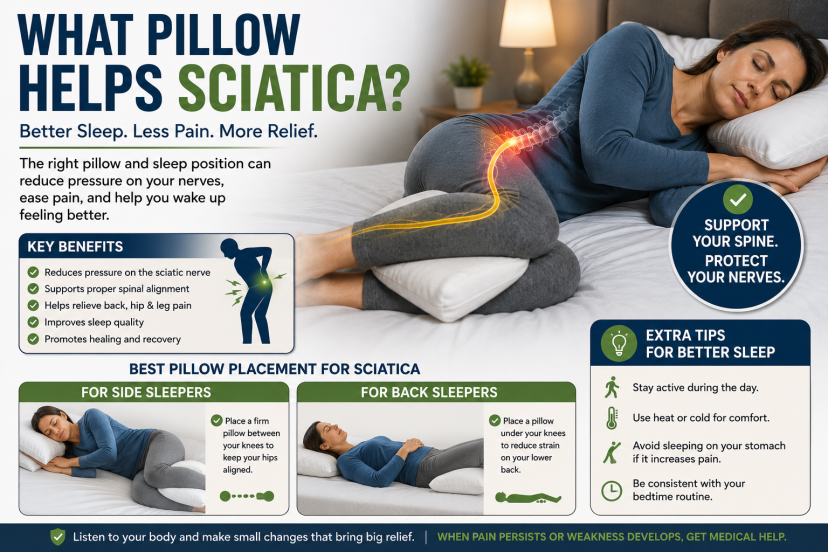
If you’re a side sleeper, start with a pillow between your knees.
When you sleep on your side without support, your upper leg may fall forward toward the mattress. This can rotate your pelvis and lower spine.
A pillow between your knees keeps the legs more evenly supported and may reduce that twisting.
Look for a pillow that is thick enough to fill the space between your knees without forcing the upper leg too high.
You can try:
- A regular firm bed pillow
- A contoured knee pillow
- A memory foam knee pillow
- A longer body pillow
You don’t necessarily need to buy anything first.
Experiment with a pillow you already own for several nights. If the position clearly improves your comfort, you can decide whether a dedicated knee pillow would be worthwhile.
Should You Sleep On The Painful Or Pain-Free Side?
There’s no universal answer.
Some people find lying on the painful side uncomfortable because of pressure around the hip and buttock. Others actually prefer that side.
Try both.
Your goal is to find the position in which your leg symptoms are least intense—not to follow a rigid rule about which side is medically “correct.”
💤 What Pillow Helps Sciatica For Back Sleepers?
Back sleepers often find that placing a pillow under the knees makes the lower back feel more relaxed.
Try lying on your back with one or two pillows beneath your knees.
A foam wedge can also work.
Slightly bending your hips and knees changes the position of your pelvis and may make lying flat more comfortable for certain people.
The pillow shouldn’t be so high that you feel folded in half.
Start with moderate support and adjust from there.
If one pillow doesn’t feel like enough, add a second thin pillow rather than immediately buying a large orthopedic wedge.
When determining what pillow helps sciatica, small adjustments can sometimes make more difference than buying a completely new sleep system.
🤰 Is Sleeping On Your Stomach Bad For Sciatica?
Not necessarily.
There is no sleeping position that everyone with sciatica must avoid.
However, stomach sleeping can be uncomfortable for some people because it may increase the curve in the lower back and requires you to turn your head to one side.
If stomach sleeping clearly aggravates your symptoms, try a thin pillow beneath your hips or lower abdomen. This can slightly change the position of your lower back.
Also consider using a thinner pillow under your head so your neck isn’t excessively extended.
If stomach sleeping feels comfortable and doesn’t worsen your symptoms, you don’t automatically need to stop.
Let your symptom response guide you.
🧩 Knee Pillow Vs. Body Pillow Vs. Wedge Pillow
When shopping online or at U.S. retailers, you’ll find dozens of products advertised as the best pillow for sciatica.
Most fall into three basic categories.
Knee Pillow
A contoured knee pillow sits between your thighs or knees.
Best for: Side sleepers.
Potential advantage: Small, inexpensive, and designed to stay between the legs.
Possible drawback: Some people move frequently and find that small knee pillows shift during sleep.
Body Pillow
A long body pillow can support your upper leg, knee, and sometimes your arms.
Best for: Side sleepers who want more full-body support.
Potential advantage: Easier to hug and reposition during the night.
Possible drawback: Takes up more bed space.
Wedge Pillow
A foam wedge can be positioned beneath your knees while sleeping on your back.
Best for: Back sleepers.
Potential advantage: Provides consistent elevation without stacking several pillows.
Possible drawback: A wedge that is too tall or firm may feel restrictive.
There isn’t a winner for everyone.
The best pillow is the one that helps you maintain a comfortable position without increasing leg symptoms.
🌙 How To Set Up Your Bed For Sciatica
Finding what pillow helps sciatica is only one part of improving nighttime comfort.
Your entire sleep setup matters.
Before going to bed, spend a few minutes arranging everything so you don’t have to struggle with pillows once your pain increases.
For side sleeping:
- Lie on whichever side feels more comfortable.
- Slightly bend your knees.
- Place a pillow between your knees and, ideally, part of your lower legs.
- Adjust the pillow until your top leg isn’t dropping toward the mattress.
- Make sure your head pillow keeps your neck comfortable.
For back sleeping:
- Lie comfortably on your back.
- Place a pillow or wedge beneath your knees.
- Adjust the height until your lower back feels relaxed.
- Avoid excessive elevation if it increases symptoms.
Don’t worry about creating textbook-perfect spinal alignment.
Comfort is the practical goal.
🌿 Natural Ways To Reduce Sciatica Before Bed
Pillows can improve positioning, but your evening habits can also influence how your body feels at bedtime.
Take A Gentle Walk
If you’ve been sitting on the couch all evening, consider a short walk before bed.
Five to fifteen minutes of comfortable walking may reduce stiffness and provide a gentle transition from daytime activity to sleep.
Avoid turning it into an intense workout.
Try Heat For Muscle Tightness
Some people find a heating pad helpful when the muscles around their lower back or buttock feel tense.
Use heat for a limited period before bed rather than falling asleep on an electric heating pad unless the product is specifically designed and instructed for that use.
Use Cold During A Painful Flare
Others prefer a cold pack when symptoms feel acutely irritated.
Always use a protective cloth between the cold pack and your skin.
Heat and cold provide temporary comfort; neither addresses every underlying cause of sciatica.
🤸 Should You Stretch Before Bed?
Gentle movement may help, but aggressive stretching isn’t necessarily better.
Sciatica can make the back of your leg feel tight. That doesn’t always mean your hamstring needs to be stretched harder.
An irritated nerve can sometimes become more uncomfortable with aggressive stretching.
Depending on your condition, a physical therapist may recommend gentle mobility, strengthening, or nerve-gliding exercises.
A useful rule is to stop an exercise if it causes:
- Shooting pain to travel farther down your leg
- Increasing tingling
- New or increasing numbness
- Noticeably worsening weakness
Your bedtime routine should leave your symptoms the same or calmer—not significantly worse.
🪑 Your Daytime Posture Can Affect Nighttime Comfort
You can buy the best pillow in the store and still struggle at night if your entire day repeatedly aggravates your symptoms.
Long periods of sitting can be difficult for some people with sciatica.
If you work at a desk, change positions regularly. A small lumbar cushion may improve sitting comfort, while an adjustable standing desk can make alternating between sitting and standing easier.
Don’t stand all day either.
Instead, rotate among sitting, standing, and short walks.
If you drive for long periods, adjust your seat so you aren’t reaching for the pedals and take movement breaks during longer trips when practical.
Better daytime movement habits may make it easier to settle comfortably at night.
🏋️ Physical Therapy And Long-Term Sciatica Relief
If you’re repeatedly searching for what pillow helps sciatica because your pain wakes you every night, consider addressing more than sleep position.
Physical therapy may help identify why particular movements or positions aggravate your symptoms.
Depending on your condition, therapy may include:
- Core and hip strengthening
- Gentle mobility work
- Walking progression
- Posture and movement education
- Nerve mobility exercises when appropriate
- Gradual return to normal activities
A therapist can also discuss sleeping positions and show you how to use pillows without forcing your spine into uncomfortable positions.
The long-term goal isn’t to become dependent on a complicated arrangement of cushions.
It’s to gradually improve your comfort, strength, movement tolerance, and confidence.
🛒 Do You Need An Expensive Sciatica Pillow?
Probably not.
Terms such as “sciatica pillow,” “orthopedic nerve pillow,” and “spinal alignment cushion” can sound impressive, but marketing claims shouldn’t be confused with medical evidence.
Start simple.
Use a regular pillow between your knees or beneath them and see how your symptoms respond.
If it helps but moves around too much, then a contoured knee pillow or wedge may be worth trying.
The same caution applies to back braces and supplements.
A brace isn’t usually a long-term solution for sleeping with sciatica, and supplements marketed as “nerve repair” products aren’t substitutes for appropriate medical care, movement, and rehabilitation.
🩺 When To See A Doctor Or Chiropractor
Nighttime sciatica doesn’t automatically indicate a serious problem, but persistent or worsening symptoms deserve attention.
Contact a healthcare professional if pain is severe, repeatedly prevents sleep, progressively worsens, or doesn’t improve despite reasonable self-care.
Get prompt medical evaluation for new or worsening leg or foot weakness or increasing numbness.
Seek urgent medical attention for new bowel or bladder control problems, numbness around the groin or saddle region, or severe or rapidly progressing weakness. These symptoms may indicate serious nerve compression.
If you’re considering chiropractic care, discuss any weakness, numbness, previous spine conditions, or neurological changes before treatment. Chiropractic treatment isn’t appropriate for every cause of sciatica.
❓ FAQs About Pillows And Sciatica
1. What Kind Of Pillow Is Best For Sciatica?
For side sleepers, a firm pillow between the knees is a simple starting point. Back sleepers may prefer a pillow or wedge beneath the knees. Comfort and symptom response are more important than the product label.
2. Does A Pillow Between The Knees Help Sciatica?
It may. A knee pillow can support the upper leg and reduce twisting through the hips and pelvis while side sleeping, which some people find more comfortable.
3. Where Should I Put A Pillow For Sciatica?
Side sleepers can place a pillow between their knees and lower legs. Back sleepers can place one beneath the knees. Experiment with thickness until the position feels supported rather than forced.
4. Is A Wedge Pillow Good For Sciatica?
A wedge beneath the knees may help some back sleepers maintain a more comfortable lower-back position. It isn’t guaranteed to relieve sciatica and should be discontinued if it increases symptoms.
5. Should I Sleep On The Side That Hurts With Sciatica?
You can sleep on whichever side produces fewer symptoms. Some people avoid the painful side, while others find it comfortable. There is no universal rule.
6. What Is The Best Sleeping Position For Sciatica?
Side sleeping with a pillow between the knees and back sleeping with support beneath the knees are two commonly comfortable options. The best position is the one that allows restful sleep without increasing your nerve symptoms.
7. Can The Wrong Pillow Make Sciatica Worse?
A poorly positioned or excessively thick pillow may place your hips or spine in an uncomfortable position and increase symptoms. If a new pillow consistently makes your leg pain, tingling, or numbness worse, stop using it.
🎯 Conclusion: What Pillow Helps Sciatica?
So, what pillow helps sciatica? You probably don’t need a complicated or expensive orthopedic product.
If you sleep on your side, start with a reasonably firm pillow between your knees. If you sleep on your back, try placing a pillow or wedge beneath your knees.
Then adjust.
Your body is giving you useful information. If one position reduces your leg symptoms and helps you sleep longer, that’s more meaningful than a product claiming to provide “perfect spinal alignment.”
Remember that pillows are primarily comfort and positioning tools. Long-term improvement may also involve staying active, reducing prolonged sitting, gradually strengthening your body, and following appropriate physical therapy or medical guidance.
Sciatica recovery can take patience, and sleep may improve gradually rather than overnight. Focus on small, repeatable changes that make your evenings more comfortable and give your body the rest it needs.
Medical Disclaimer: This article is for general educational and informational purposes only and is not a substitute for professional medical advice, diagnosis, or treatment. Sciatica has multiple possible causes, and sleep recommendations may need to be individualized. Consult a qualified healthcare professional about persistent, severe, or worsening symptoms. Seek urgent medical care for new bowel or bladder problems, saddle-area numbness, or significant or rapidly worsening weakness.
 Explore more:
- Why Driving Makes Sciatica Worse
- Can Lifting Heavy Objects Cause Sciatica?
- Can I Work With Sciatica?