Can Lifting Heavy Objects Cause Sciatica? What To Know Before You Lift Again
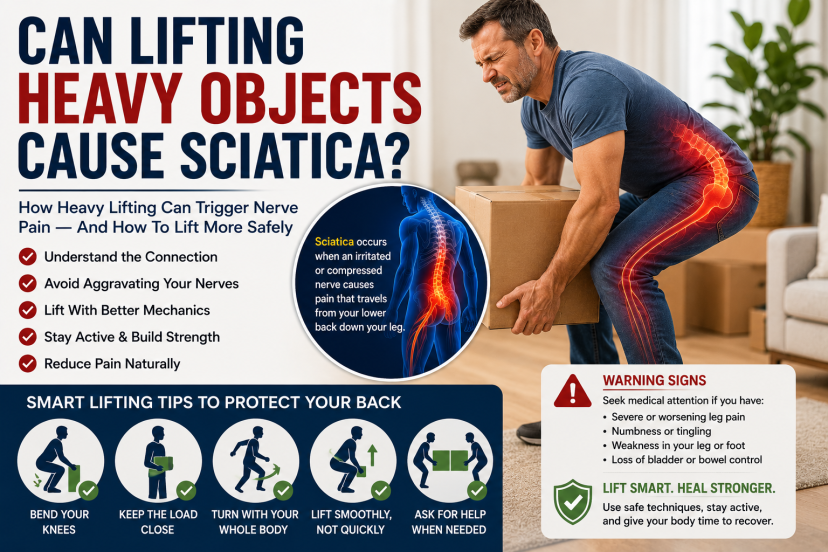
You bend down to pick up a heavy box, bag of mulch, laundry basket, or piece of furniture—and suddenly feel a sharp pain in your lower back. Hours later, that pain begins traveling into your buttock or down your leg. If this sounds familiar, you may be wondering, can lifting heavy objects cause sciatica?
Heavy lifting can sometimes trigger sciatica symptoms, particularly when a lift places more stress on your lower back than it is currently prepared to handle. In some cases, lifting may contribute to a disc problem that irritates a spinal nerve. In others, it may simply aggravate a nerve that was already sensitive.
The good news is that having sciatica doesn’t mean you need to avoid lifting forever. Understanding your current limits, improving your lifting habits, staying active, and gradually rebuilding strength can help you return to everyday activities with more confidence.
Here’s what you need to know before picking up that next heavy object.
🏋️ Quick Answer: Can Lifting Heavy Objects Cause Sciatica?
Yes, lifting heavy objects can trigger or aggravate sciatica, especially when the load is beyond your current capacity or the lift involves awkward bending and twisting. A lifting incident may sometimes contribute to a herniated disc that irritates a spinal nerve.
However, lifting isn’t automatically harmful to your back. Appropriate technique, manageable loads, gradual strength training, and avoiding sudden increases in workload can reduce unnecessary strain.
Key Takeaways
Most likely cause: A demanding or awkward lift may irritate the lower back or contribute to disc-related nerve irritation, producing pain that travels into the buttock or leg.
Usually serious? Usually not. Many sciatica episodes improve with conservative care, but progressive weakness or certain neurological symptoms need prompt medical attention.
First thing to check: If you’re asking whether lifting heavy objects can cause sciatica, notice whether the pain travels below your buttock into your leg and whether you also have tingling, numbness, or weakness.
Best solution: Temporarily modify painful lifting, remain gently active, rebuild strength gradually, and learn lifting strategies appropriate for your work and everyday activities.
🧠 How Heavy Lifting Can Trigger Sciatica
Sciatica isn’t simply lower-back pain.
The term describes symptoms caused by irritation or compression involving nerve roots in the lower spine that contribute to the sciatic nerve.
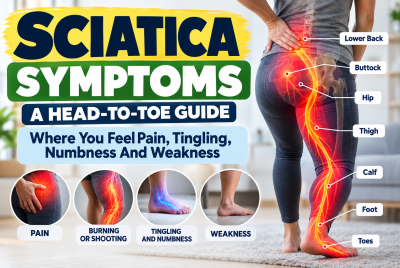
Common symptoms include:
- Shooting pain through the buttock and leg
- Burning or electric-like pain
- Tingling or pins and needles
- Numbness
- Lower-back discomfort
- Leg or foot weakness
A demanding lift can place substantial forces through the lower back. This doesn’t mean those forces are automatically dangerous—the human spine is designed to handle loads.
Problems are more likely when the demand exceeds what your body is currently prepared to tolerate.
For example, someone who rarely lifts anything heavier than groceries may suddenly spend a weekend moving furniture. That abrupt increase in workload may provoke symptoms.
Herniated Discs And Lifting
One possible explanation for sciatica following a lifting incident is a herniated disc.
Spinal discs sit between the vertebrae and help distribute forces. Disc material can sometimes bulge or herniate and irritate a nearby nerve root.
A single lifting event may be associated with the onset of symptoms, although disc changes can also develop gradually and occur in people who don’t remember any particular injury.
That’s an important distinction.
The fact that your sciatica started while lifting doesn’t necessarily mean you permanently “damaged” your spine.
📦 Which Lifting Habits May Aggravate Sciatica?
When people ask can lifting heavy objects cause sciatica, they often assume the weight itself is the only factor.
It isn’t.
How often you lift, how awkward the object is, how far it is from your body, and whether you’re fatigued all influence the demands placed on you.
Situations that may be more challenging include:
- Lifting something unexpectedly heavy
- Repeated lifting when you’re already fatigued
- Carrying an object far away from your body
- Lifting while simultaneously twisting
- Moving awkward furniture without assistance
- Suddenly increasing lifting volume
- Repeatedly lifting from floor level
- Rushing through a task because you’re tired
The solution isn’t becoming afraid of bending or lifting.
Instead, make the task fit your current capacity.
🚫 Should You Stop Lifting Completely With Sciatica?
Usually, permanent avoidance isn’t the goal.
During a painful flare, temporarily reducing heavy or repetitive lifting may be sensible, especially when a specific task consistently sends pain farther down your leg.
But avoiding lifting indefinitely can have disadvantages.
If you stop using your back and legs because you’re afraid of another flare, your strength and confidence may gradually decrease. Then ordinary activities can begin to feel more demanding.
A better approach is temporary modification followed by gradual rebuilding.
For example, instead of lifting a 50-pound bag, divide the contents into smaller loads when possible.
Instead of moving a couch alone, get help.
As symptoms improve, gradually increase the amount you lift through appropriate rehabilitation or strength training.
✅ How To Lift More Comfortably With Sciatica
There’s no single lifting technique that guarantees you will never experience back pain.
However, several practical habits can make demanding lifts more manageable.
Keep The Load Close
Holding a heavy box close to your torso is generally easier than holding the same box at arm’s length.
Before lifting, move close to the object.
Avoid reaching across a trunk, deep shelf, or large table while simultaneously trying to lift something heavy.
Use Your Hips And Knees
Allow your hips and knees to participate in the movement rather than relying entirely on your lower back.
You don’t necessarily need a perfect deep squat for every object.
Use a comfortable position that allows you to control the load.
Move Your Feet When Turning
Twisting isn’t inherently dangerous, but combining a demanding lift with sudden rotation may be uncomfortable during a sciatica flare.
When carrying something heavy, turning your whole body by moving your feet may feel more controlled.
Ask For Help
There’s no prize for moving a sofa alone.
Use another person, hand truck, dolly, cart, or lifting equipment when the load is beyond what you can comfortably control.
🏗️ Lifting At Work When You Have Sciatica
Warehouse workers, nurses, construction workers, landscapers, delivery drivers, mechanics, caregivers, and many other employees can’t simply eliminate lifting.
If your job repeatedly triggers symptoms, talk with your healthcare provider and employer about temporary modifications when necessary.
Possible changes might include:
- Reducing unusually heavy lifts
- Using mechanical lifting equipment
- Team lifting
- Alternating demanding and lighter tasks
- Taking appropriate movement breaks
- Gradually returning to normal duties
If sciatica causes significant leg or foot weakness, some physical tasks may become unsafe.
Don’t attempt to carry a heavy load up stairs or work at height if your leg is unexpectedly giving way.
Safety comes first.
🚶 What To Do After Lifting Triggers Sciatica
If you develop sciatic pain after moving something heavy, your first instinct may be to lie down and avoid movement.
Brief rest can be understandable when pain is severe, but prolonged bed rest generally isn’t the preferred strategy for uncomplicated sciatica.
Instead, try comfortable movement.
Short walks around your home can help you avoid becoming excessively stiff.
Change positions regularly rather than spending the entire day on the couch.
If a movement dramatically worsens your leg symptoms, modify it temporarily.
Should You Use Heat Or Ice?
Either may provide temporary comfort.
A cold pack may feel soothing during an acute painful flare, while heat may help when the muscles around your lower back or buttock feel tight.
Use a cloth barrier to protect your skin and follow product instructions.
Neither heat nor cold repairs a herniated disc or removes nerve compression, but temporary relief may make normal movement easier.
🤸 Should You Stretch After Hurting Your Back While Lifting?
Be cautious about immediately performing aggressive stretches.
When sciatica causes the back of your leg to feel tight, it’s tempting to stretch the hamstrings as hard as possible.
But an irritated nerve can sometimes create a sensation that feels like muscle tightness.
Aggressive stretching may increase symptoms.
Instead, use comfortable movement and exercises that have been recommended for your particular condition.
Stop if an exercise causes:
- Shooting pain that travels farther down your leg
- Increasing tingling
- Increasing numbness
- New or worsening weakness
A physical therapist can determine which movements are appropriate for you.
🏋️ Physical Therapy And Strength Training After Sciatica
If lifting heavy objects caused sciatica symptoms or repeatedly triggers them, physical therapy may help you rebuild your capacity.
Treatment can include:
- Core strengthening
- Hip and leg strengthening
- Lifting practice
- Gradual resistance training
- Mobility exercises
- Movement education
- Job-specific training
- Gradual return to normal activity
Good rehabilitation doesn’t teach you that your back is fragile.
Instead, it helps your body become better prepared for the loads you encounter at home, at work, and during exercise.
Gradual Progression Matters
Imagine you’ve avoided lifting for six weeks.
Your first workout back probably shouldn’t involve attempting your previous maximum weight.
Start with loads you can control comfortably.
Increase weight, repetitions, or duration gradually.
This gives muscles and other tissues time to adapt and helps you regain confidence.
🪑 Daily Habits That Can Support Recovery
If you’re wondering can lifting heavy objects cause sciatica, don’t focus exclusively on the few seconds when the lift occurred.
Your entire day influences how prepared your body is for physical activity.
If you sit for hours at work, break up long periods with standing or walking.
A lumbar cushion may improve sitting comfort for some people, while an adjustable standing desk can make position changes easier.
Regular walking and appropriate strength training can help maintain general conditioning.
Prioritize adequate sleep and recovery, especially after physically demanding days.
Avoid going from almost no physical activity during the week to an entire weekend of heavy yard work.
Your body generally handles gradual increases better than sudden spikes in activity.
🧰 Do Back Braces Or Supplements Prevent Lifting-Related Sciatica?
Back braces are widely sold in U.S. pharmacies, home improvement stores, and online, but they shouldn’t create a false sense that you can safely lift more than your current capacity.
A brace may have specific short-term uses for certain people or conditions. Ask a healthcare professional whether one is appropriate for you.
Don’t rely on a brace instead of rebuilding strength and improving your lifting tolerance.
Similarly, supplements advertised as “nerve repair” products aren’t proven solutions for mechanical nerve compression.
Certain nutritional deficiencies can affect nerve health, but taking extra supplements doesn’t automatically fix sciatica from a herniated disc.
Discuss supplements with your physician or pharmacist, particularly if you take prescription medications.
🛡️ How To Prevent Sciatica When Lifting
You can’t guarantee you’ll never experience sciatica, but you can reduce unnecessary risk.
Focus on practical habits:
- Build Strength Gradually: Prepare your body for the loads you regularly encounter.
- Warm Up Before Demanding Work: A few minutes of movement may help you transition into heavier activity.
- Keep Heavy Loads Manageable: Divide large loads when practical.
- Use Equipment: Dollies and carts exist for a reason.
- Ask For Help: Team lifting can make awkward objects easier to control.
- Avoid Sudden Workload Spikes: Don’t cram months of yard work into one afternoon.
- Take Breaks When Fatigued: Technique and control may decline when you’re exhausted.
- Stay Generally Active: Walking and strength training can help maintain your physical capacity.
Your goal shouldn’t be avoiding lifting forever.
It should be becoming capable enough that normal lifting feels manageable.
🩺 When To See A Doctor Or Chiropractor
Most lifting-related back pain and sciatica episodes aren’t emergencies, but certain symptoms deserve professional evaluation.
Contact a healthcare provider if pain is severe, progressively worsening, repeatedly returns with normal activities, or doesn’t improve with reasonable conservative care.
Get prompt evaluation if you develop new or worsening leg or foot weakness, significant numbness, difficulty walking, or foot drop.
Seek urgent medical attention if you develop new bowel or bladder control problems, numbness around your groin or saddle region, or severe or rapidly progressing weakness. These may indicate significant nerve compression.
If you’re considering chiropractic treatment, disclose any numbness, weakness, previous spinal problems, or neurological changes before treatment. Spinal manipulation isn’t appropriate for every cause of sciatica.
If you’re planning to speak with a healthcare professional, you can also use our Sciatica Doctor Visit Checklist to organize your symptoms, questions, medications, and other important details before your appointment. Together, these free tools can make it easier to spot patterns and give your healthcare professional a clearer picture of what you’ve been experiencing.
❓ FAQs About Heavy Lifting And Sciatica
1. Can Heavy Lifting Suddenly Cause Sciatica?
A demanding lift can sometimes trigger sciatica symptoms, particularly if it contributes to irritation of a spinal nerve or aggravates an existing problem. However, not every episode means serious spinal damage.
2. Can Lifting A Heavy Box Cause A Herniated Disc?
A herniated disc can sometimes become symptomatic during or after lifting, although disc changes may also develop gradually without one identifiable injury.
3. Should I Avoid Lifting If I Have Sciatica?
You may need to temporarily modify heavy or repetitive lifting during a painful flare. Permanent avoidance usually isn’t the goal. Gradual return to lifting can be part of recovery.
4. How Long Should I Wait Before Lifting Again After Sciatica?
There is no universal timeline. Return depends on your symptoms, strength, job demands, and underlying cause. Start with manageable loads and increase gradually. Significant weakness requires professional guidance.
5. What Is The Safest Way To Lift With Sciatica?
Keep manageable loads close to your body, use your hips and knees comfortably, avoid uncontrolled movements, and get assistance for loads beyond your current ability.
6. Can Weightlifting Make Sciatica Worse?
Certain exercises or loads can aggravate symptoms during a flare, but strength training isn’t automatically bad for sciatica. Properly progressed resistance exercise may eventually improve your capacity and confidence.
7. Can I Go Back To The Gym After Sciatica?
Many people can return to gym training as symptoms improve. Begin below your previous intensity, monitor how your symptoms respond, and gradually increase the challenge. A physical therapist can help if you’re uncertain.
🌟 Can Lifting Heavy Objects Cause Sciatica? The Bottom Line
So, can lifting heavy objects cause sciatica? Yes, a demanding or awkward lifting episode can sometimes trigger symptoms, particularly when the activity exceeds what your lower back is currently prepared to tolerate or contributes to nerve irritation.
But that doesn’t mean lifting is inherently dangerous—or that you should spend the rest of your life protecting your back from every heavy object.
During a painful flare, modify demanding tasks. Keep moving within your tolerance, use help or lifting equipment when necessary, and gradually rebuild strength as symptoms improve.
Your long-term goal is resilience, not avoidance.
Sciatica recovery often takes patience, and occasional discomfort doesn’t automatically mean you’ve damaged your back again. Focus on steady improvements in walking, strength, lifting tolerance, and everyday movement.
With sensible progression and appropriate professional guidance when needed, many people can return to lifting, working, exercising, and normal daily life with greater confidence.
Medical Disclaimer: This article is for general educational and informational purposes only and does not replace professional medical advice, diagnosis, or treatment. Sciatica and back pain can have many causes, and recommendations should be individualized when symptoms are severe or persistent. Consult a qualified healthcare professional for new or worsening weakness, significant numbness, or ongoing symptoms. Seek urgent medical attention for new bowel or bladder problems, saddle-area numbness, or severe or rapidly progressing weakness.
 Explore more: