How Is Sciatica Pain Treated? A Complete Guide To Treatment And Management
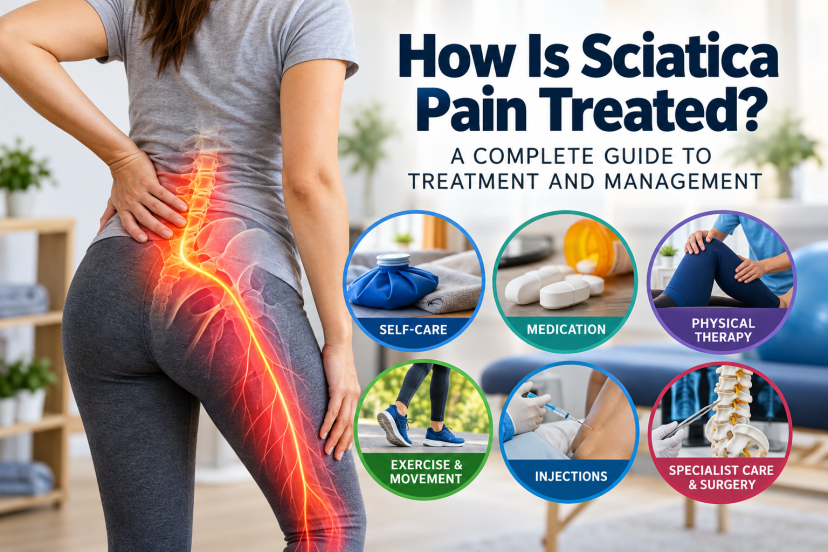
Sciatica Treatment And Pain Management: From Early Self-Care To Specialist Treatment
Most cases of sciatica improve without surgery through conservative self-care, targeted movement, and medication. Sciatica can make ordinary activities surprisingly difficult. Sitting through a meeting, getting out of bed, driving to work, climbing stairs, bending over to put on shoes, or simply walking around the grocery store may suddenly become painful. When that happens, one of the first questions is usually: How is sciatica pain treated?
There is no single treatment pathway that is right for everyone. Sciatica describes a pattern of symptoms associated with irritation or compression affecting nerve roots that contribute to the sciatic nerve. The underlying problem, severity of symptoms, presence of weakness or numbness, how long symptoms have lasted, and how much they interfere with daily life can all influence treatment.
For many people, treatment begins conservatively rather than with surgery. Cleveland Clinic notes that many people recover with approaches such as stretching, medication, or physical therapy, while more severe cases may require surgery.
The important thing is to think of treatment as a pathway, not as a search for one miracle remedy.
You may start by modifying painful activities and continuing gentle movement. If symptoms persist, physical therapy or other medical treatment may become appropriate. For selected people with severe or persistent symptoms, injections or specialist evaluation may enter the picture. Surgery is generally considered when there is a specific reason for it rather than automatically because someone has sciatica.
This guide walks through that pathway from beginning to end.
Medical Disclaimer: This article is for general educational and informational purposes only. It is not intended to provide medical advice, diagnosis, or treatment or to replace care from a qualified healthcare professional.
Quick Answer: How Is Sciatica Pain Treated?
Sciatica pain is commonly treated first with conservative measures such as remaining reasonably active, modifying activities that aggravate symptoms, heat or cold, appropriate pain medication when suitable, and physical therapy or guided exercise.
Treatment should be matched to the suspected cause and severity of the symptoms.
If symptoms are severe, worsening, or not improving with conservative treatment, a healthcare professional may consider additional evaluation and options such as specialist care or an epidural injection. Surgery may be considered in selected cases, particularly when non-surgical treatment has not improved pain or function and imaging shows a problem that corresponds with the person’s symptoms.
Sudden or progressive weakness, loss of bladder or bowel control, numbness around the groin or saddle area, or other serious neurological symptoms require prompt medical assessment.
Key Takeaways
Most likely treatment path: For many people asking how sciatica pain is treated, management starts conservatively with appropriate activity, symptom management, and sometimes physical therapy rather than immediately moving to injections or surgery.
Usually serious? Sciatica can be extremely painful without being medically dangerous. However, significant or worsening weakness, bladder or bowel problems, saddle-area numbness, or rapidly worsening neurological symptoms require urgent evaluation.
First thing to check: Consider how severe the symptoms are, how long they have been present, whether they are improving or worsening, and whether you have numbness, weakness, or other neurological changes.
Best solution: There is no universal best treatment for sciatica. The most appropriate approach depends on the underlying cause, severity, duration, and effect on everyday function.
Treatment Depends On The Cause And Severity
The first step in understanding sciatica treatment is recognizing that two people with similar leg pain may need different approaches.
Sciatica can occur when a spinal nerve root is irritated or compressed. A herniated disc is one possible cause, but spinal stenosis, degenerative changes, and other conditions can also produce sciatic-type symptoms.
The treatment plan therefore depends on more than how painful your leg feels.
A healthcare professional may consider:
- Where your pain travels.
- Whether symptoms affect one or both legs.
- Whether you have tingling or numbness.
- Whether there is muscle weakness.
- How long symptoms have lasted.
- Whether they are improving, stable, or worsening.
- Which positions and activities trigger symptoms.
- How much your normal activities are affected.
- Whether there are warning signs suggesting a more urgent problem.
1. Someone with mild symptoms that began several days ago and are already improving may require little more than self-management and time.
2. Someone who has had persistent pain for weeks and is struggling to work, sleep, or walk may benefit from a more structured treatment program.
3. Someone developing significant weakness or bladder or bowel symptoms requires a different level of evaluation entirely.
This is why sciatic nerve pain treatment should be individualized rather than based solely on a pain score.
Learn more about what can cause sciatica and why the underlying cause can affect the treatment approach.
Early-Stage Self-Care
When symptoms are mild and there are no warning signs, the first stage of treatment often takes place at home.
The goal is not necessarily to make every trace of pain disappear immediately. Early management is often about keeping symptoms manageable while allowing you to continue moving safely as the irritated area settles.
That may include temporarily modifying activities that clearly aggravate the pain.
For example, if repeated bending causes a sharp surge of pain down your leg, you might reduce unnecessary bending for a while and change how you perform unavoidable tasks.
If prolonged sitting makes symptoms worse, shorter sitting periods with regular changes of position may be easier.
If standing still is difficult but walking feels better, brief periods of movement may help you avoid staying in one uncomfortable position for too long.
Cleveland Clinic recommends options including cold and heat, over-the-counter medication when appropriate, and gentle movement and stretching as possible self-care measures for mild symptoms.
The word gentle matters.
Trying to aggressively stretch or exercise your way through severe nerve pain can sometimes make symptoms more irritable. Early self-care should usually be about tolerable movement rather than proving how much discomfort you can endure.
Watch The Direction Your Symptoms Are Moving
One useful observation during this stage is whether your overall pattern is improving.
Ask yourself:
- Is the pain less intense than several days ago?
- Can you walk a little farther?
- Can you sit slightly longer?
- Are you sleeping better?
- Is pain becoming less frequent?
- Or are symptoms spreading, intensifying, or being joined by increasing numbness or weakness?
A simple symptom diary can be helpful because day-to-day fluctuations sometimes make progress difficult to recognize.
Staying Active Vs Resting
When sciatica hurts, staying in bed can feel like the safest option.
A short period of relative rest may be understandable when symptoms suddenly flare. But prolonged bed rest generally isn’t the goal.
Cleveland Clinic notes that short periods of rest may help during the first day or two, while too much rest can make pain worse and slow recovery. NICE guidance similarly recommends encouraging people with low back pain with or without sciatica to continue normal activities as appropriate.
Think in terms of relative rest rather than complete rest.
Relative rest means temporarily reducing activities that clearly provoke symptoms while continuing tolerable movement.
That might mean:
- Taking several short walks instead of one long walk.
- Alternating between sitting, standing, and walking.
- Temporarily reducing heavy lifting.
- Taking breaks during housework.
- Breaking large jobs into smaller tasks.
- Changing positions before pain becomes severe.
The appropriate amount of activity differs from person to person.
You do not need to remain completely motionless simply because you have sciatica, but you also do not need to push through every painful activity.
The objective is sustainable movement.
Heat And Cold
Heat and cold are inexpensive symptom-management tools, but neither one repairs a herniated disc or permanently removes nerve compression.
Their role is more modest: they may help make symptoms more manageable.
Cold
A cold pack may feel useful during an acute flare, particularly when the area feels irritated after activity.
Cleveland Clinic suggests that ice may help with pain and swelling during the first few days and recommends using it for around 20 minutes at a time.
Avoid placing ice directly against bare skin.
Heat
Heat may feel more comfortable when the surrounding muscles are stiff or tense.
Some people prefer heat before gentle movement because it helps them feel less guarded.
Others find cold more soothing.
You do not have to force yourself to use one simply because someone else says it worked for them.
If either heat or cold increases your symptoms, stop using it.
Most importantly, think of these as comfort measures within a larger treatment pathway, not as cures for the underlying cause of sciatica.
Medication Overview
Medication can sometimes make pain manageable enough for someone to sleep, move, and participate in rehabilitation.
But sciatica medication is more complicated than simply choosing the strongest painkiller.
Over-the-counter products may include NSAIDs such as ibuprofen or naproxen and pain relievers such as acetaminophen. However, suitability depends on your health history, other medications, age, and other factors.
NICE specifically cautions that evidence of benefit from NSAIDs for sciatica is limited and that potential gastrointestinal, liver, and cardio-renal risks need to be considered. When NSAIDs are prescribed for sciatica, NICE advises using the lowest effective dose for the shortest appropriate period.
Over-the-counter does not mean risk-free.
The FDA advises following Drug Facts labels carefully because excessive or inappropriate use of common pain medicines can cause serious harm. NSAIDs can pose risks including stomach bleeding and kidney problems in some people, while excessive acetaminophen can cause severe liver damage.
Be particularly careful about accidentally taking the same active ingredient in multiple products. Acetaminophen, for example, is included in hundreds of prescription and nonprescription products.
If you have kidney disease, liver disease, heart problems, stomach ulcers, take blood thinners or other medications, are pregnant, or have other medical conditions, discuss appropriate pain relief with a healthcare professional or pharmacist.
Prescription treatment may sometimes be considered depending on the situation, but the appropriate medication needs to be individualized.
Medication is usually best thought of as one possible component of treatment—not the entire treatment plan.
Physical Therapy For Sciatica
Physical therapy is one of the most important steps in the treatment pathway for many people whose symptoms are persistent or significantly affecting daily activities.
A physical therapist can evaluate how you move rather than simply handing you a generic sheet of stretches.
That assessment may look at:
- Walking.
- Sitting posture.
- Spinal movement.
- Hip mobility.
- Strength.
- Balance.
- Activities that reproduce symptoms.
- Movements that reduce symptoms.
- Work or household activities that are difficult.
The treatment plan can then be adapted to your particular presentation.
Cleveland Clinic notes that physical therapy may use guided exercises to improve strength and reduce pressure on the affected nerve.
Physical therapy may also help you learn how to move while you recover.
That can be particularly valuable if pain has made you afraid of bending, walking, exercising, or performing normal activities.
Physical Therapy Is More Than Stretching
People often imagine sciatica physical therapy as a collection of hamstring stretches.
It can be much broader.
Depending on your individual situation, therapy might involve mobility work, strengthening, progressive exercise, movement modification, education, and a gradual return to normal activities.
NICE recommends considering exercise programs for an episode or flare of low back pain with or without sciatica, taking the person’s needs, preferences and capabilities into account.
The best program is therefore not necessarily the most complicated one.
It is the one that is appropriate for your condition and that you can perform consistently.
Exercise And Movement
Exercise is where generic online advice can become problematic.
A movement that feels helpful to one person with sciatica may aggravate another person’s symptoms.
That is partly because sciatica is a symptom pattern rather than one single injury.
For example, some people tolerate walking well but struggle with sitting. Others may find prolonged standing or walking more provocative.
Some people are particularly sensitive to bending forward. Others notice pain with different spinal positions.
For that reason, exercise should ideally be guided by your symptoms and, when needed, a healthcare professional or physical therapist.
Start With Tolerable Movement
Rather than asking: What is the best exercise for sciatica?
a more useful question may be: What movement can I tolerate now that helps me gradually return to normal function?
That could initially be a short walk.
Later, it may involve mobility exercises, strengthening, and progressively more demanding activities.
Pay attention to what happens during and after exercise. Sciatica can sometimes cause sensory changes farther down the leg, including numbness or tingling in the toes.
Mild discomfort does not always mean damage, but a movement that repeatedly produces a major increase in radiating leg pain, new numbness, or weakness deserves caution.
If you are uncertain about what is safe, seek individualized guidance.
Managing Everyday Activities
Formal treatment may occupy only a small part of your week.
The rest of the time, you still have to sit, sleep, work, cook, shop, drive, climb stairs, and take care of your home.
That makes everyday activity management an important part of treatment for sciatica.
Sitting
If sitting aggravates your symptoms, try changing position regularly rather than searching for one “perfect” posture.
A supportive chair may help. Some people also find that very soft couches or low chairs are harder to get in and out of during a flare.
Driving
Driving combines prolonged sitting with limited opportunities to change position.
For longer journeys, breaks may help. Adjusting the seat so that you can comfortably reach the pedals without straining may also reduce unnecessary stress.
If pain, numbness or weakness affects your ability to control the vehicle safely, don’t drive until you have appropriate medical advice and can operate the vehicle safely.
Bending
If bending forward triggers leg pain, temporarily changing how you perform repeated bending tasks can make daily life easier.
Bring frequently used objects to a convenient height where possible.
When you must bend, move slowly and avoid combining awkward bending and twisting with heavy lifting.
Learn more about why bending forward can make sciatica worse.
Stairs
Take stairs at a controlled pace and use the handrail if necessary.
If pain or weakness makes stairs unsafe, get individualized advice rather than repeatedly forcing yourself through the activity.
Sleeping
There is no single sleeping position guaranteed to relieve sciatica.
Experiment with positions that reduce symptoms and allow you to sleep. Pillows may sometimes make side or back sleeping more comfortable.
Housework And Shopping
Instead of doing everything at once, divide physically demanding jobs into smaller blocks.
A ten-minute task followed by a change of position may be easier than an hour of repetitive bending, lifting or standing.
This practical section of the treatment pathway matters because recovery is not just about performing exercises correctly. It is also about learning how to manage the activities that fill the other 23 hours of your day.
When Symptoms Aren’t Improving
Sciatica often improves over time, but not everyone follows the same schedule.
Cleveland Clinic reports that many cases improve within roughly four to six weeks, although more severe cases may last longer.
If several weeks pass without meaningful improvement, it may be time to reassess the situation.
That does not automatically mean something dangerous is happening.
It may mean your diagnosis needs another look, your rehabilitation program needs adjusting, or additional evaluation may be appropriate.
Seek medical evaluation sooner if symptoms are severe or worsening, or if you develop significant neurological changes.
A clinician may reconsider:
- Whether the symptoms really represent sciatica.
- Which nerve root may be affected.
- Whether weakness is present.
- Whether another condition could explain the symptoms.
- Whether imaging would change treatment.
- Whether specialist evaluation is appropriate.
Routine imaging is not necessary for every new episode of sciatica. NICE recommends considering imaging in specialist settings when the result is likely to change management.
The next step should therefore be based on your clinical situation rather than simply reaching an arbitrary number of painful days.
If symptoms continue despite treatment, understanding how sciatica is diagnosed can help you know what may happen during a medical evaluation.
Epidural Injections
If severe sciatic pain continues despite conservative treatment, an epidural injection may sometimes enter the conversation.
An epidural steroid injection places medication around the area near irritated spinal nerves.
The goal is generally to reduce inflammation and pain, not to permanently repair the structural cause.
NICE says epidural injections of local anesthetic and steroid may be considered for people with acute and severe sciatica.
Cleveland Clinic similarly lists spinal injections among medical treatments that may provide short-term relief in some cases.
That distinction is important.
An injection may sometimes create a period of improved pain control that allows someone to move, sleep, or participate more effectively in rehabilitation.
But an injection is not guaranteed to work, and the duration of relief can vary.
Your healthcare professional can discuss whether an injection is appropriate based on your diagnosis, symptoms, medical history, and previous response to conservative treatment.
Specialist Care
A referral to a specialist does not necessarily mean you are going to have surgery.
Specialist evaluation may simply be the next step when:
- Symptoms are severe.
- Pain persists despite appropriate conservative treatment.
- The diagnosis is uncertain.
- Weakness is present or progressing.
- Symptoms significantly restrict normal function.
- An injection is being considered.
- Imaging needs specialist interpretation.
- Surgery might eventually be an option.
Depending on your healthcare system and symptoms, this may involve a spine specialist, neurologist, pain specialist, orthopedic surgeon, neurosurgeon, physical medicine and rehabilitation physician, or another appropriate clinician.
Bring useful information with you.
Write down when symptoms began, where the pain travels, what causes it to worsen, what makes it better, whether you have numbness or weakness, what treatments you have already tried, and how those treatments affected you.
That can make the consultation much more productive.
When Surgery Enters The Conversation
One of the biggest fears people have after developing sciatica is: Am I going to need back surgery?
For many people, the answer is no.
Cleveland Clinic states that most people recover without needing surgery and describes surgery as generally being considered when pain is severe, nerve damage is a concern, or other treatments have not helped.
Surgery becomes more relevant when there is a clearly identified structural problem that corresponds with the person’s symptoms and conservative treatment has not provided adequate improvement.
NICE recommends considering spinal decompression for people with sciatica when non-surgical treatment has not improved pain or function and radiological findings correspond with their sciatic symptoms.
Procedures vary depending on the underlying problem. For example, a diskectomy or microdiscectomy may remove part of a disc that is pressing on a nerve. A laminectomy removes part of the vertebral bone to create more space when nerves are compressed.
The specific procedure, and whether surgery is appropriate at all, requires individualized specialist evaluation.
Situations That Require Faster Medical Attention
Some neurological changes should not simply be watched at home.
Seek urgent medical evaluation for symptoms such as:
- New loss of bladder or bowel control.
- Numbness around the genitals, inner thighs, or saddle area.
- Severe or rapidly progressing leg weakness.
- Major neurological changes that are worsening quickly.
These symptoms can indicate serious nerve compression requiring prompt assessment.
Recovery After Treatment
Recovery rarely happens in a perfectly straight line.
You may have three good days followed by a more uncomfortable one.
That does not automatically mean treatment has failed.
Look at the broader trend.
- Can you walk farther than two weeks ago?
- Can you sit longer?
- Are you sleeping more comfortably?
- Is leg pain less intense?
- Can you perform more daily activities?
- Are flare-ups becoming less frequent or shorter?
Functional improvements can be just as meaningful as a change in a pain score.
Gradually Rebuild Capacity
As symptoms improve, the next goal is not simply to avoid pain forever.
It is to rebuild your ability to perform normal activities.
Depending on your needs, that might include:
- Longer walks.
- More time sitting.
- Returning to work.
- Strength training.
- Lifting.
- Gardening.
- Household tasks.
- Driving longer distances.
- Recreational exercise.
Progress gradually.
Trying to make up for several inactive weeks in one weekend can trigger a flare and make it harder to judge what your body currently tolerates.
What Sciatica Treatments Cannot Promise
Sciatica attracts a huge market of products, programs, and treatments promising rapid relief.
Be cautious about guarantees.
No legitimate treatment can promise that every person with sciatica will be pain-free in a specific number of days.
Treatment also cannot guarantee that symptoms will never return.
A brace, special chair, mattress, supplement, massage device, stretching routine, or exercise program might feel useful to an individual person, but that does not make it a universal solution.
Be especially cautious when a treatment claims to:
- Cure all sciatica.
- Permanently “release” the sciatic nerve in minutes.
- Eliminate the need for medical evaluation.
- Work regardless of the underlying cause.
- Guarantee permanent results.
- Require you to purchase an expensive proprietary device or supplement before explaining the evidence.
Good sciatica care is usually less dramatic.
It involves identifying what is happening, watching for warning signs, controlling symptoms, maintaining appropriate activity, rebuilding function, and escalating treatment when there is a clinical reason to do so.
Building A Long-Term Sciatica Management Plan
Once the worst pain settles, it can be tempting to forget about your back completely.
But recovery is a useful opportunity to identify what helped and how you can respond if symptoms return.
A long-term plan does not need to dominate your life. It may simply involve several habits.
Keep Moving Regularly
Regular physical activity can help maintain general strength, mobility, and conditioning.
Choose activities you enjoy enough to continue.
Walking, strength training, swimming, or other forms of exercise may all be possibilities depending on your health and abilities.
Maintain Strength
A progressive strengthening program may help you tolerate everyday demands such as lifting, carrying, climbing stairs, and prolonged activity.
If you are unsure how to begin, a physical therapist can help design a suitable program.
Avoid Fear-Based Movement
After a painful episode, people sometimes become afraid of normal movement.
They may stop bending, lifting, or exercising long after the acute symptoms have improved.
The goal is usually not lifelong avoidance.
When appropriate, gradually rebuilding confidence and capacity is a more practical long-term strategy.
Have A Flare-Up Plan
If symptoms have happened before, decide in advance how you will respond to a mild recurrence.
Your plan might include temporarily modifying provocative activities, staying gently active, using previously recommended symptom-management strategies, and contacting your healthcare professional if symptoms do not settle or warning signs develop.
Track What Matters
Instead of recording pain alone, consider tracking:
- Walking tolerance.
- Sitting tolerance.
- Sleep.
- Exercise.
- Medication use.
- Numbness or tingling.
- Weakness.
- Activities that trigger symptoms.
- Activities that seem to help.
This provides a more complete picture of recovery.
A simple sciatica symptom and recovery tracker can help you record pain, numbness, activity levels, and changes in everyday function over time.
Questions To Ask Your Healthcare Professional
If your sciatica requires medical care, arriving with specific questions can help you understand the treatment pathway.
Consider asking:
- What do you think is causing my sciatica symptoms?
- Do I need imaging now, or would it be unlikely to change treatment?
- Are there particular activities I should temporarily modify?
- Which activities should I continue?
- Would physical therapy be appropriate for me?
- Which exercises are suitable for my specific symptoms?
- Which pain medicines, if any, are safe with my medical history and current medications?
- How long should I try conservative treatment before being reassessed?
- What signs would mean I should contact you sooner?
- Is the numbness or weakness I’m experiencing concerning?
- Would an injection be appropriate in my situation?
- At what point would you consider referring me to a specialist?
- If surgery is being discussed, what specific problem would the procedure address?
- What improvement should I realistically expect from the recommended treatment?
- What can I do to reduce the impact of future flare-ups?
Writing the answers down can be useful, particularly when pain makes it difficult to remember everything discussed during an appointment.
If you’re planning to speak with a healthcare professional, you can also use our Sciatica Doctor Visit Checklist to organize your symptoms, questions, medications, and other important details before your appointment. Together, these free tools can make it easier to spot patterns and give your healthcare professional a clearer picture of what you’ve been experiencing.
Frequently Asked Questions
1. How Is Sciatica Pain Treated At Home?
Mild sciatica may initially be managed with appropriate activity modification, gentle movement, short periods of relative rest when necessary, and heat or cold for comfort. Some people use over-the-counter pain medication when medically appropriate. Avoid prolonged bed rest. If symptoms are severe, worsening, associated with weakness or numbness, or not improving over time, seek medical evaluation.
2. What Is The Most Effective Treatment For Sciatica?
There is no single treatment that is most effective for every person. The appropriate treatment depends on the underlying cause, severity, duration, and presence of neurological symptoms. Many people begin with conservative management and gradually increase activity. Others benefit from physical therapy. Selected people may require medication, injections, specialist evaluation, or surgery. Treatment should be matched to the individual rather than based on a universal sciatica remedy.
3. How Long Does Sciatica Take To Improve?
Recovery varies considerably. Cleveland Clinic notes that many cases improve within four to six weeks, although more severe cases may continue for weeks or months. Rather than focusing only on the calendar, monitor your overall progress. Improved walking, easier sitting, better sleep, reduced leg pain, and increased ability to perform normal activities are all useful signs. If symptoms are not improving after several weeks—or are worsening—talk with a healthcare professional.
4. Do You Need Surgery For Sciatica?
Most people with sciatica do not automatically need surgery. Conservative approaches such as appropriate activity, symptom management, and physical therapy are commonly tried first. Surgery may be considered when non-surgical treatment has not adequately improved pain or function and imaging identifies a problem consistent with the symptoms. Severe or progressive neurological problems can also change the urgency of treatment. A spine specialist can explain whether surgery is appropriate and what specific problem the procedure would be intended to correct.
5. When Should I See A Healthcare Professional About Sciatica?
Consider making an appointment if your symptoms are severe, persist for several weeks without meaningful improvement, significantly interfere with normal activities, or include ongoing numbness or weakness. Seek more urgent medical evaluation if weakness is rapidly worsening or you develop loss of bladder or bowel control, saddle-area numbness, or other major neurological changes.
Final Thoughts: Following The Sciatica Treatment Pathway
When you’re in pain, it is understandable to want one clear answer to how is sciatica pain treated. But sciatica treatment rarely comes down to one medication, one stretch, or one procedure. For many people, the pathway starts conservatively.
You continue tolerable movement, modify activities that clearly aggravate symptoms, and use appropriate symptom-management strategies. If recovery is slower or symptoms interfere substantially with everyday life, physical therapy and medical evaluation may become more important.
If symptoms remain severe or persistent, the next stage may involve further assessment, specialist care, or an injection. Surgery enters the discussion for selected people when there is an appropriate clinical reason—particularly when non-surgical treatment has failed to improve pain or function or when significant neurological problems are present.
Throughout that pathway, the objective is bigger than simply chasing a lower pain score.
It is to help you sleep, sit, stand, walk, work, drive, exercise, and return to everyday life as safely and comfortably as possible.
And once you are improving, treatment gradually becomes management: rebuilding strength, increasing activity, understanding your triggers, and knowing what to do if symptoms flare again.
That is why a good sciatica treatment plan is not just about what you do when pain is at its worst.
It is a pathway from pain control to movement, from movement to recovery, and from recovery back to normal life.
Medical disclaimer: This article is for general educational and informational purposes only and is not a substitute for professional medical advice, diagnosis, or treatment. Seek advice from a qualified healthcare professional regarding symptoms, medications, and treatment options appropriate for your individual situation.
Explore more:
- Sciatica Symptom & Recovery Tracker
- Sciatica Doctor Visit Checklist
- What Is Sciatic Nerve Pain? A Complete Beginner’s Guide
- What Are The Symptoms Of Sciatica Pain?
- What Causes Sciatic Nerve Pain?
- How Do I Know If I Have Sciatica?
- How Is Sciatica Diagnosed?