What Causes Sciatic Nerve Pain? 10 Common Causes Of Sciatica Explaine

What Causes Sciatica And Why Does Pain Travel Down The Leg?
Sciatica can seem to appear out of nowhere. One day your lower back or leg feels normal, and the next you may notice a sharp, burning, aching, or electric pain traveling through your buttock and down your leg. Naturally, one of the first questions is: What causes sciatic nerve pain?
The simple answer is that sciatica usually develops when one or more of the nerve roots that contribute to the sciatic nerve become irritated, inflamed, compressed, or injured. Herniated discs, spinal stenosis, arthritic changes, and other structural problems in the lower spine are common reasons this can happen.
But the complete answer is more complicated.
Two people can have very similar changes on an MRI and experience completely different symptoms. One person may have severe leg pain, while another has little or no pain. You can also develop sciatica without significant lower back pain, and some conditions outside the spine can create symptoms that feel surprisingly similar to sciatica.
This guide explains the major causes of sciatic nerve pain, where the problem usually begins, why symptoms vary so much, and how healthcare professionals may work out what is irritating the nerve.
Medical Disclaimer: This article is for general educational and informational purposes only. It is not intended to provide medical advice, diagnosis, or treatment or to replace care from a qualified healthcare professional.
Quick Answer: What Causes Sciatic Nerve Pain?
Sciatic nerve pain usually occurs when a nerve root in the lower spine that contributes to the sciatic nerve becomes compressed, irritated, or inflamed. Common causes include a herniated disc, spinal stenosis, bone spurs associated with osteoarthritis, spondylolisthesis, and other degenerative changes in the spine.
Less commonly, injury, pregnancy-related changes, cysts, tumors, infections, or other conditions can affect the nerves.
Importantly, everyday factors such as prolonged sitting, repeated lifting, excess body weight, and low physical activity may increase the likelihood of certain back problems or aggravate existing symptoms, but they are not necessarily the underlying anatomical cause of sciatica.
Key Takeaways
Most likely cause: When people ask what causes sciatic nerve pain, a common explanation is irritation or compression of a nerve root in the lower spine, often linked to a herniated disc or age-related narrowing and degenerative changes.
Usually serious? Most cases are not medical emergencies, but severe or rapidly worsening weakness, numbness around the groin or saddle area, or new loss of bladder or bowel control requires urgent medical evaluation.
First thing to check: Pay attention to where the pain travels, whether you have numbness, tingling or weakness, and which movements or positions consistently make the symptoms better or worse.
Best solution: Treatment depends on the underlying cause and severity. A healthcare professional can evaluate persistent, severe, unusual, or worsening symptoms and determine whether examination, imaging, physical therapy, medication, or other treatment is appropriate.
Start At The Nerve Root: Where Sciatica Usually Begins
Although we commonly call it “sciatic nerve pain,” the problem often begins before the individual nerves have joined together to form the large sciatic nerve in the leg.
Several nerve roots emerge from the lower portion of the spine and sacral region. These nerve fibers eventually come together to form the sciatic nerve, which travels through the buttock and down the leg.
If one of these nerve roots becomes compressed or irritated, pain and other neurological symptoms can be felt farther down the nerve pathway.
This is why a problem in your lower spine can make your:
- Buttock hurt.
- Thigh burn or ache.
- Calf tingle.
- Foot feel numb.
- Toes develop pins and needles.
- Leg feel weak.
The painful area and other symptoms can sometimes give healthcare professionals clues about which nerve root may be affected.
This also explains an important point about sciatica:
The place where you feel the pain isn’t necessarily where the underlying problem is located.
Your calf may hurt intensely even though there is nothing structurally wrong with your calf. The source of the symptoms may instead be irritation of a nerve root in your lower spine. Sciatica is therefore better understood as a pattern of nerve-related symptoms rather than simply a painful leg.
If you’re unsure whether what you’re experiencing fits the typical pattern, learn more about the symptoms of sciatica pain, including pain, tingling, numbness, and weakness.
10 Common Causes Of Sciatica Explained
1. Herniated Disc
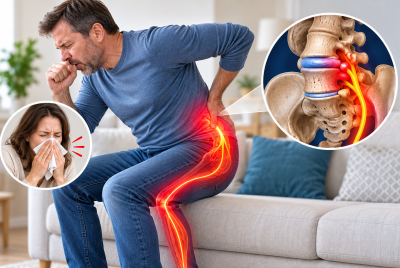
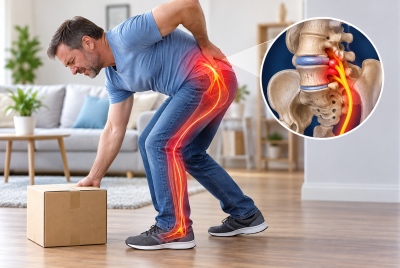
A lumbar herniated disc is one of the best-known causes of sciatica. Your spine contains discs between the vertebrae. These discs help cushion the bones and allow your spine to move.
Each disc contains a softer inner material surrounded by a tougher outer layer. When part of the disc protrudes or herniates, it may come into contact with a nearby nerve root.
If the affected nerve root contributes to the sciatic nerve, symptoms can travel into the buttock and leg.
Depending on the location and severity, you may experience:
- Sharp or shooting leg pain.
- Burning sensations.
- Tingling.
- Numbness.
- Pain extending into the calf or foot.
- Muscle weakness.
- Lower back pain.
Some people notice sciatica pain when bending forward, particularly when a sensitive nerve root is affected by a disc problem.
This helps explain why coughing and sneezing can send sciatica pain down your leg when a nerve root is already irritated. If a nerve root is already sensitive because of a disc problem, that additional pressure may make the radiating pain more noticeable.
However, a herniated disc on an MRI does not automatically mean it is responsible for someone’s symptoms.
Disc changes can exist without causing pain. Healthcare professionals therefore consider imaging findings alongside your symptoms and physical examination rather than assuming that every abnormal-looking disc is the source.
2. Lumbar Spinal Stenosis
Spinal stenosis means that one or more spaces within the spine have become narrowed. When this narrowing occurs in the lumbar spine, there may be less room available for the nerve roots. If a nerve becomes compressed or irritated, symptoms can extend into the buttock and leg.
Lumbar spinal stenosis becomes more common with age because several age-related changes may contribute to narrowing, including:
- Thickening of ligaments.
- Enlarged facet joints.
- Bone spurs.
- Disc degeneration.
- Bulging discs.
- Changes in spinal alignment.
The symptom pattern may differ from classic disc-related sciatica.
People with lumbar spinal stenosis sometimes find that symptoms become worse while:
- Standing for a long time.
- Walking.
- Extending the lower back.
Symptoms may improve when sitting down or leaning slightly forward because certain positions can temporarily increase the available space around the nerves.
Some people describe being able to walk farther while leaning over a shopping cart than when walking completely upright.
Not everyone with spinal stenosis develops sciatica. The important issue is whether the narrowing actually affects the relevant nerve tissue.
3. Bone Spurs And Arthritic Changes
Osteoarthritis can affect the small joints of the spine, known as facet joints. As joints change over time, the body may develop additional bone around them. These projections are commonly called bone spurs, or osteophytes.
A bone spur itself isn’t necessarily painful. The problem arises when arthritic changes contribute to narrowing around a nerve root.
For example, changes around the facet joints may reduce the size of the openings through which spinal nerves leave the spine. This is sometimes referred to as foraminal stenosis.
If the opening becomes narrow enough to irritate or compress a nerve root, symptoms may include:
- Radiating leg pain.
- Tingling.
- Numbness.
- Burning sensations.
- Weakness.
This process generally develops gradually rather than suddenly.
Age-related spinal changes also tend to occur together. Someone may have disc degeneration, facet-joint arthritis, bone spurs, and spinal narrowing at the same time.
Therefore, there isn’t always one isolated structure responsible for the symptoms.
4. Spondylolisthesis
Spondylolisthesis occurs when one vertebra shifts or slips relative to the vertebra below it.
Some people have mild spondylolisthesis without knowing it because it doesn’t cause symptoms. In other cases, the change in spinal alignment can reduce the space available for nerves. If a nerve root becomes compressed, the result may be sciatica.
Symptoms can include:
- Lower back pain.
- Buttock pain.
- Radiating leg pain.
- Tingling.
- Numbness.
- Tightness in the hamstrings.
- Leg weakness.
- Difficulty standing or walking for prolonged periods.
There are different types of spondylolisthesis.
It may be associated with age-related degeneration, a stress injury in part of a vertebra, congenital differences in spinal structure, or trauma.
The degree of slippage also doesn’t perfectly predict how much pain someone will experience.
A relatively small change may cause significant symptoms if it affects a nerve in a particularly sensitive location, while another person can have visible slippage without substantial nerve symptoms.
5. Degenerative Disc And Spinal Changes
The word degenerative can sound alarming, but in medicine it often describes changes that develop gradually with aging and use.
The discs between the vertebrae can lose water content and height over time. Facet joints can change. Ligaments may thicken. Bone spurs can form.
Collectively, these changes can alter the amount of room available around the nerve roots.
Degenerative disc changes may therefore contribute indirectly to sciatica by creating conditions in which a nerve becomes irritated or compressed.
For example, loss of disc height may reduce the size of the opening where a nerve exits the spine.
Degenerative changes can also contribute to:
- Spinal stenosis.
- Foraminal narrowing.
- Osteoarthritis.
- Spondylolisthesis.
This is one reason it can be misleading to search for a single cause on an MRI.
Several small changes may work together. It is equally important to remember that age-related changes on imaging are common and don’t always produce symptoms.
An imaging report that mentions “degeneration” does not automatically mean something is seriously wrong or that the changes explain your pain.
6. Foraminal Stenosis
Spinal nerves leave the spinal column through small openings called foramina. Foraminal stenosis occurs when one of these openings becomes narrower.
Possible contributors include:
- Loss of disc height.
- Bulging or herniated discs.
- Bone spurs.
- Facet-joint enlargement.
- Spondylolisthesis.
- Other degenerative spinal changes.
If the narrowing puts pressure on a nerve root, it can produce pain, numbness, tingling, or weakness along the path supplied by that nerve.
This can look and feel like typical sciatica.
Foraminal narrowing is particularly useful to understand because it illustrates why the phrase “pinched nerve” can mean different things.
The nerve may not necessarily be compressed by one large herniated disc. Instead, the space around it may gradually become smaller because of several structural changes.
7. Injury And Trauma
Injury can sometimes cause sciatica directly or indirectly.
Examples include:
- A hard fall.
- Vehicle collision.
- Sports injury.
- Significant twisting injury.
- Pelvic injury.
- Spinal fracture.
Trauma can potentially damage spinal structures, cause inflammation, produce a disc injury, change spinal alignment, or directly injure nerve tissue.
A relatively ordinary muscle strain, however, should not automatically be called sciatica simply because it causes lower back or buttock pain.
True sciatica generally involves symptoms associated with nerve irritation.
A healthcare professional may be particularly interested in recent trauma if your symptoms appeared suddenly after an accident or injury.
Severe pain following substantial trauma, especially when accompanied by weakness, numbness, difficulty walking, or other neurological symptoms, warrants medical evaluation.
8. Pregnancy-Related Factors
Some people experience sciatica-like or true nerve-related symptoms during pregnancy.
Pregnancy creates several changes that can affect the lower back and pelvis, including:
- Changes in posture.
- Altered spinal loading.
- Changes in body weight and center of gravity.
- Increased stress on muscles and joints.
- Changes around the pelvis.
However, not every episode of buttock or leg pain during pregnancy is caused by compression of the sciatic nerve.
Pelvic girdle pain, muscular pain, joint-related discomfort, and other pregnancy-related problems can sometimes produce symptoms that resemble sciatica.
For this reason, new or significant symptoms during pregnancy are best discussed with an appropriate healthcare professional rather than self-diagnosed.
9. Cysts, Tumors And Other Space-Occupying Problems
Much less commonly, something occupying space near the spinal nerves can cause sciatica.
Examples can include certain:
- Cysts.
- Tumors.
- Abnormal growths.
- Hematomas.
- Infections or abscesses.
These are not the explanation for most cases of sciatica. However, they are part of the reason healthcare professionals pay attention to the overall clinical picture rather than assuming every case of radiating leg pain is a routine disc problem.
Symptoms that may justify prompt medical evaluation include pain accompanied by factors such as unexplained fever, significant unexplained weight loss, a history of cancer, significant recent infection, or other unusual systemic symptoms.
The presence of one of these factors does not prove a serious cause. It simply means that professional evaluation may be important.
10. Direct Sciatic Nerve Irritation Or Injury
Not all sciatic-type pain originates at the spinal nerve root. The sciatic nerve itself can potentially be irritated or injured farther along its pathway.
This is much less common than lumbar nerve-root problems, but it can happen following certain injuries or other conditions affecting the pelvis, buttock, or upper leg.
This distinction matters because sciatica is often used casually to describe almost any pain traveling through the buttock and leg.
In clinical practice, identifying where along the nerve pathway the problem originates can affect diagnosis and treatment.
Less Common Causes Of Sciatic Nerve Pain
Beyond the major causes above, several uncommon conditions can affect the nerves of the lower spine or sciatic nerve pathway.
These may include:
- Severe spinal infections.
- Certain tumors.
- Cysts near spinal joints or nerve roots.
- Significant pelvic masses.
- Major spinal fractures.
- Cauda equina compression.
- Certain inflammatory or neurological disorders.
These conditions account for a small proportion of people with typical sciatica symptoms.
Nevertheless, recognizing unusual patterns is important.
Seek urgent medical attention for sciatica-like symptoms accompanied by new loss of bladder or bowel control, numbness around the genitals or saddle area, or severe or rapidly worsening weakness.
Those symptoms can indicate serious compression of nerves in the lower spine and should not simply be monitored at home.
Sciatica-Like Conditions: When It Feels Like Sciatica But Isn’t
Not every pain that travels through the buttock or leg is true sciatica. Several other problems can produce overlapping symptoms.
Piriformis And Deep Gluteal Problems
The sciatic nerve travels through the deep buttock region near several muscles and other structures. Irritation or entrapment in this region can sometimes produce pain that resembles lumbar sciatica. This is often discussed under terms such as deep gluteal syndrome.
The symptoms may include buttock pain and discomfort extending into the leg, particularly during certain hip movements or prolonged sitting.
Sacroiliac Joint Pain
The sacroiliac joints connect the pelvis and lower spine. Pain from this region can sometimes spread through the buttock and upper leg. It may feel similar to sciatica, although it does not necessarily involve irritation of a spinal nerve root.
Hip Problems
Hip osteoarthritis and other hip conditions can produce pain around the:
- Groin.
- Buttock.
- Thigh.
- Knee.
Because these areas overlap with places where sciatica may be felt, determining the source based on location alone can be difficult.
Hamstring Problems
A hamstring injury can cause pain in the back of the thigh. This may be mistaken for sciatica, especially when symptoms began after exercise or physical activity.
Peripheral Neuropathy
Peripheral nerve disorders can cause:
- Burning.
- Tingling.
- Numbness.
- Electric sensations.
- Weakness.
These symptoms may overlap with sciatica. However, the distribution and underlying cause can differ.
Vascular Problems
Certain circulation problems can cause leg pain during activity. Because spinal stenosis can also produce leg discomfort while walking, clinicians may sometimes need to distinguish nerve-related symptoms from vascular causes.
The key point is simple: Pain traveling down the leg does not automatically equal sciatica.
Risk Factors Vs Actual Causes Of Sciatica
This distinction is one of the most important parts of understanding why you get sciatica. A cause is the problem actually affecting the nerve.
For example:
Herniated disc → nerve-root irritation → sciatica symptoms.
A risk factor is something associated with an increased chance of developing a condition that may eventually affect the nerve.
Potential risk factors can include:
- Increasing age.
- Repeated heavy lifting.
- Frequent bending or twisting.
- Prolonged sitting.
- Low levels of physical activity.
- Excess body weight.
- Smoking.
- Previous back injury.
- Certain physically demanding occupations.
These factors do not mean that you will develop sciatica. And they should not necessarily be described as direct causes. For example, sitting at a desk for eight hours doesn’t automatically “pinch your sciatic nerve.”
But prolonged sitting may aggravate an already sensitive back or leg, and lifestyle or occupational factors may contribute to conditions associated with sciatica in some people.
Similarly, excess body weight isn’t a diagnosis explaining exactly which nerve is irritated. It may contribute to mechanical loading and be associated with other factors affecting spinal health.
Understanding this distinction helps prevent unnecessary blame. Someone can be physically active, use good lifting technique, maintain a healthy weight, and still develop a herniated disc.
Another person may have several risk factors and never experience sciatica.
Why Two People With Similar MRI Scans May Feel Completely Different
One of the most interesting things about back and nerve pain is that imaging and symptoms don’t always match perfectly.
Imagine two people whose MRI scans both show a lumbar disc bulge. Person A has severe burning pain extending all the way into the foot.
Person B has no sciatica at all.
How is that possible?
Several factors may matter.
Location Matters
A disc change may only cause sciatica if it affects the relevant nerve tissue.
A disc can bulge without touching a nerve root.
Nerve Irritation Isn’t Only About Pressure
Mechanical compression is important, but inflammation and the sensitivity of nerve tissue can also influence symptoms.
The relationship is more complicated than:
More compression = more pain.
People Process Pain Differently
Pain is produced through interaction between injured or irritated tissues, nerves, the spinal cord, and the brain. Sleep, stress, previous pain experiences, and many other biological and psychological factors can influence how strongly pain is experienced without making the symptoms imaginary.
Imaging Shows Structure — Not Pain
An MRI is extremely useful when clinically appropriate, but it is still an image of anatomy. It cannot directly show how much pain a person feels.
This is why healthcare professionals usually combine imaging, when needed, with the patient’s history and physical examination.
Can You Have Sciatica Without Back Pain?
Yes. You can have sciatica even if your lower back doesn’t hurt much — or at all.
The most noticeable symptom may instead be pain in your:
- Buttock.
- Thigh.
- Calf.
- Ankle.
- Foot.
- Toes.
You might also experience numbness, tingling, burning, or weakness without significant back pain. For some people, the symptoms extend all the way into the foot, and sciatica can cause numbness in the toes when the affected nerve pathway supplies that area.
This makes sense when you remember how nerve symptoms work. If a nerve root in the lower spine is irritated, the brain may interpret signals as coming from areas supplied by that nerve farther down the leg. In other words, the source can be in the lower spine while the symptoms are primarily felt in the leg.
This is one reason sciatica can initially be confusing. Someone may spend time stretching or massaging a painful calf even though the calf itself isn’t the primary source of the problem.
Finding The Likely Source Of Your Sciatica
There isn’t one home test that can reliably identify the exact cause of every case of sciatica.
Healthcare professionals generally build a picture from several pieces of information.
1. Where Does The Pain Travel?
The path of symptoms can provide clues. A clinician may ask whether pain stays in the buttock or travels through the thigh, calf, foot, or toes.
2. What Does It Feel Like?
Nerve-related symptoms are often described as:
- Burning.
- Shooting.
- Electric.
- Tingling.
- Pins and needles.
- Numbness.
But descriptions vary significantly from person to person.
3. What Makes It Worse?
Patterns can be informative.
You may notice symptoms becoming worse with:
- Sitting.
- Standing.
- Walking.
- Bending forward.
- Going downstairs.
- Lifting.
- Driving.
- Coughing.
- Sneezing.
Different patterns may point clinicians toward different possible sources, although no single movement proves the diagnosis.
4. What Makes It Better?
Relieving positions can also provide useful clues. For example, some people with spinal stenosis find sitting or leaning forward more comfortable, while other forms of sciatica may behave differently.
5. Are There Neurological Changes?
A healthcare professional may evaluate:
- Muscle strength.
- Reflexes.
- Sensation.
- Walking.
- Leg movement.
- Nerve-tension responses.
These findings can help identify whether a particular nerve root may be affected.
Pay close attention to changes in strength, and learn more about leg and foot weakness with sciatica and when it may need medical evaluation.
6. Is Imaging Necessary?
Not everyone with new sciatica automatically needs an MRI.
Imaging may become more relevant when symptoms are severe, persistent or progressive, when significant neurological changes are present, when a serious underlying condition is suspected, or when the result could change treatment decisions.
The important question isn’t simply: “What does my MRI show?”
It is: “Do the findings match my symptoms and examination?”
That connection is what helps identify the likely source.
Track Your Sciatica Symptoms And Prepare For Your Appointment
When you’re trying to figure out what may be causing your sciatic nerve pain, it can help to keep a simple record of how your symptoms change from day to day. Our Sciatica Symptom & Recovery Tracker can help you record your pain level, where symptoms travel, numbness or tingling, activities, sleep, and changes in your recovery over time.
If you’re planning to speak with a healthcare professional, you can also use our Sciatica Doctor Visit Checklist to organize your symptoms, questions, medications, and other important details before your appointment. Together, these free tools can make it easier to spot patterns and give your healthcare professional a clearer picture of what you’ve been experiencing.
Frequently Asked Questions About What Causes Sciatica
1. What Is The Most Common Cause Of Sciatic Nerve Pain?
A lumbar herniated disc is one of the most common causes of sciatica. Disc material can irritate or compress a nearby nerve root, producing pain, tingling, numbness, or weakness that travels into the leg. In older adults, degenerative changes and lumbar spinal stenosis are also important causes.
2. Can Sitting Too Much Cause Sciatica?
Prolonged sitting may aggravate sciatica and is associated with factors that can affect back health, but sitting itself doesn’t necessarily mean the sciatic nerve is being damaged. If a nerve root is already irritated, certain seated positions may make symptoms more noticeable. Regular movement breaks and changing positions can be helpful for general comfort, but persistent leg pain should be evaluated based on its underlying cause rather than blamed solely on sitting.
3. Why Did My Sciatica Suddenly Start?
Sciatica can appear suddenly if a disc herniates or an existing spinal problem begins irritating a nerve root. Symptoms can sometimes start after bending, lifting, twisting, coughing, or another movement. In other cases, there may be no obvious triggering event. The absence of a dramatic injury doesn’t mean the symptoms aren’t real. Some spinal changes develop gradually and only become symptomatic when a nerve becomes sufficiently irritated.
4. Can You Get Sciatica Without A Herniated Disc?
Yes. Although disc herniation is a common cause, sciatica can also result from spinal stenosis, foraminal stenosis, bone spurs, osteoarthritis, spondylolisthesis, degenerative spinal changes, trauma, and several less common conditions. This is why the cause shouldn’t be assumed based solely on symptoms.
5. When Should Sciatica Be Checked By A Doctor?
Consider medical evaluation if your symptoms are severe, keep returning, continue for several weeks, interfere substantially with walking or normal activities, or are accompanied by persistent numbness or weakness. Seek urgent medical care for symptoms such as new bladder or bowel control problems, numbness around the genitals or saddle area, or severe or rapidly worsening leg weakness. These symptoms can occasionally indicate serious nerve compression that requires prompt assessment.
The Bottom Line: What Really Causes Sciatica?
If you’re trying to understand what causes sciatic nerve pain, start with the nerves rather than the location where you feel the pain. Sciatica usually develops because a nerve root contributing to the sciatic nerve becomes irritated, compressed, inflamed, or injured.
Common underlying problems include:
- Herniated discs.
- Lumbar spinal stenosis.
- Osteoarthritis and bone spurs.
- Spondylolisthesis.
- Degenerative disc and spinal changes.
- Foraminal stenosis.
- Injury or trauma.
- Pregnancy-related factors.
- Less common space-occupying conditions.
- Direct irritation or injury of the sciatic nerve.
But identifying an abnormality is only part of the picture. Many spinal changes can exist without symptoms, and two people with similar-looking scans may have completely different experiences.
That is why the most useful evaluation considers your symptoms, their distribution, neurological findings, physical examination, medical history, and imaging when appropriate.
Most importantly, don’t assume every case of leg pain is caused by sciatica or that every abnormality on a scan must be the cause.
Persistent or worsening symptoms deserve an individualized assessment, particularly when pain is accompanied by numbness or weakness.
Medical Disclaimer: This article is for general educational and informational purposes only and is not intended to diagnose sciatica or any other medical condition. It does not replace professional medical advice, diagnosis, or treatment. Speak with a qualified healthcare professional about persistent, severe, worsening, or concerning symptoms.
Explore more:
- Sciatica Symptom & Recovery Tracker
- Sciatica Doctor Visit Checklist
- What Is Sciatic Nerve Pain? A Complete Beginner’s Guide
- What Are The Symptoms Of Sciatica Pain?