Can Being Overweight Cause Sciatica? The Connection And What May Help
When sciatica makes walking, sitting, sleeping, or exercising uncomfortable, it’s natural to search for anything that might be contributing to the problem. If you’re carrying extra weight, you may wonder, Can being overweight cause sciatica, and whether losing weight would make the shooting pain in your leg disappear.
The relationship isn’t quite that simple. Excess body weight doesn’t automatically cause sciatica, and people of every body size can develop sciatic nerve symptoms. However, higher body weight is associated with a greater risk of lumbar radicular pain and sciatica, and it may add to the physical demands placed on the lower back.
The encouraging part is that you don’t need dramatic weight loss before you can start helping your back. Regular movement, gradual strengthening, better sitting habits, comfortable walking, and appropriate medical or physical therapy care can all be useful.
Let’s look at what the evidence suggests and what practical steps you can take today.
⚖️ Quick Answer: Can Being Overweight Cause Sciatica?
Being overweight doesn’t directly cause every case of sciatica, but excess body weight may increase the risk of developing sciatica and can contribute to greater mechanical demands on the lower back. Sciatica itself usually results from irritation or compression of a spinal nerve root.
Weight management may be one part of a broader recovery plan, alongside regular activity, strengthening, physical therapy, and treatment of the underlying cause.
Key Takeaways
Most likely cause: Sciatica usually results from irritation or compression of a lower spinal nerve, commonly associated with conditions such as a herniated disc or spinal stenosis.
Usually serious? Usually not. Many cases improve with conservative care, although progressive weakness and certain neurological symptoms require prompt evaluation.
First thing to check: If you’re wondering if being overweight can cause sciatica, remember that weight may be one contributing risk factor rather than the only explanation for your symptoms.
Best solution: Focus on sustainable movement, gradual strengthening, healthy nutrition, appropriate weight management when needed, and professional treatment for persistent nerve symptoms.
🧠 How Body Weight And Sciatica May Be Connected
Sciatica is nerve-related pain.
It typically occurs when a nerve root in the lower spine becomes irritated or compressed. Depending on which nerve is affected, symptoms may travel from your lower back or buttock into your thigh, calf, foot, or toes.
Common symptoms include:
- Shooting or burning leg pain
- Tingling or pins and needles
- Numbness
- Buttock discomfort
- Lower-back pain
- Leg or foot weakness
Common underlying causes include herniated discs, spinal stenosis, and age-related changes affecting the lower spine.
So, can being overweight cause sciatica by itself?
Usually, it is more accurate to think of higher body weight as one possible risk factor rather than a single direct cause.
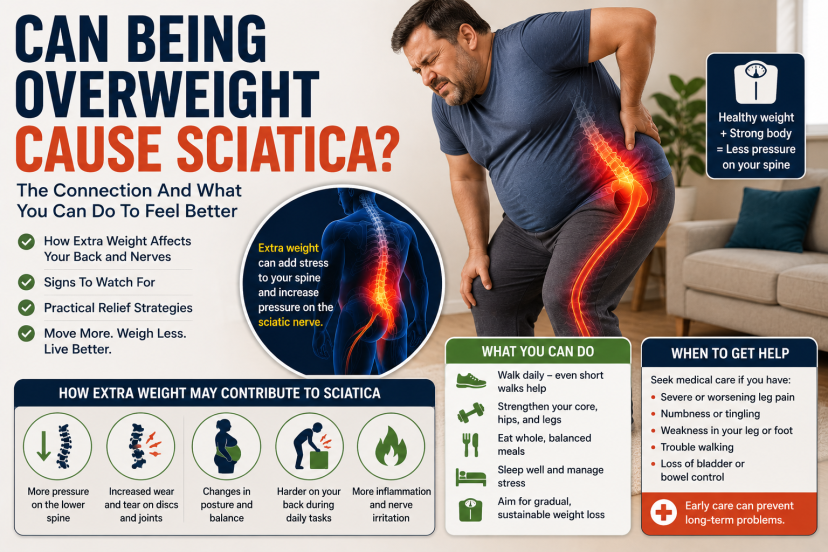
Your spine regularly supports and transfers forces created by your body and everyday activities. Greater body mass can increase some of those physical demands, particularly during walking, lifting, bending, and prolonged standing.
📊 Does Research Link Obesity And Sciatica?
Research has found an association between overweight or obesity and lumbar radicular pain or sciatica.
That doesn’t mean everyone with obesity will develop sciatica. It also doesn’t prove that weight alone caused a particular person’s symptoms.
Many factors can influence sciatica risk, including:
- Age
- Genetics
- Occupation
- Physical activity
- Smoking
- Spinal anatomy
- Previous back problems
- Overall health
This distinction matters because blaming every episode of sciatica on someone’s weight isn’t medically useful.
A person at a lower weight can develop a herniated disc and severe sciatica, while someone at a higher weight may never experience sciatic nerve pain.
Think in terms of risk factors and contributing factors, not blame.
🚶 Can Losing Weight Help Sciatica?
If higher body weight is contributing to the overall demands on your lower back, gradual weight loss may be beneficial for general health and mobility.
But weight loss shouldn’t be presented as a guaranteed cure for sciatica.
Losing 10 or 20 pounds doesn’t necessarily remove a herniated disc or reverse spinal stenosis. Likewise, you shouldn’t delay other useful treatment while waiting to reach a target weight.
If weight management is appropriate for you, combine it with:
- Regular comfortable movement
- Gradual strength training
- Good sleep
- Nutritious eating habits
- Physical therapy when needed
- Medical treatment of the underlying condition
Most importantly, don’t believe you have to become thin before you’re “allowed” to exercise or rehabilitate your back.
Recovery can start now.
👟 Walking With Sciatica When You Carry Extra Weight
Walking is one of the simplest ways to remain active, but starting can be intimidating when your leg already hurts.
You don’t need 10,000 steps on day one.
Start with a distance you can tolerate comfortably.
That might mean walking for five minutes, resting, and taking another short walk later.
If you’re deconditioned or haven’t exercised recently, several short walks throughout the day may be more realistic than one long session.
Make Walking Easier
Try these practical strategies:
- Choose Flat Ground: Start with predictable surfaces rather than steep hills.
- Wear Comfortable Shoes: You don’t need expensive specialty footwear, but shoes should feel stable and comfortable.
- Start Slowly: Give your body time to warm up.
- Track Time Instead Of Miles: Five comfortable minutes is meaningful progress.
- Increase Gradually: Add small amounts rather than suddenly doubling your walking distance.
If walking causes pain to travel progressively farther down your leg or you develop weakness or instability, get professional guidance.
🪑 Sitting, Body Weight And Sciatica
People wondering can being overweight cause sciatica sometimes focus entirely on the scale while overlooking hours of uninterrupted sitting.
For many people, prolonged sitting is a more obvious daily symptom trigger.
If you work at a desk, try changing positions regularly.
A supportive adjustable chair may make sitting more comfortable. A small lumbar cushion can also help some people maintain a comfortable lower-back position.
If your chair feels narrow or restrictive, choose equipment designed to comfortably accommodate your body rather than forcing yourself into an unsuitable chair.
A sit-stand desk can make position changes easier.
But remember: standing all day isn’t automatically better.
Alternate between sitting, standing, and walking.
🏋️ Strength Training Can Be Part Of The Solution
Many people with sciatica become afraid of resistance exercise.
They worry that lifting weights will further compress the spine or damage the nerve.
But appropriate, gradually progressed strength training can help improve your capacity for everyday activities.
Depending on your condition and experience level, a program may eventually include exercises for your:
- Legs
- Hips
- Glutes
- Trunk
- Upper body
You don’t need to start with heavy weights.
Body-weight exercises, resistance bands, machines, or light free weights may all have a place depending on your abilities.
The important part is matching the exercise to your current tolerance.
If you’re experiencing significant weakness or severe symptoms, work with a physical therapist or healthcare professional before starting a demanding exercise program.
🤸 What Stretches Help Sciatica?
Stretching can feel good, but more stretching isn’t necessarily better.
Sciatic nerve irritation may create a pulling or tight sensation through the back of the thigh or calf. That sensation doesn’t always mean the muscles need aggressive stretching.
In some cases, forcefully stretching the leg may increase nerve-related symptoms.
A physical therapist may recommend specific mobility exercises, strengthening movements, or nerve-gliding exercises depending on the cause of your sciatica.
Stop or modify an exercise if it causes:
- Increasing shooting pain
- Tingling that spreads farther down your leg
- Increasing numbness
- New or worsening weakness
Your exercise program should help you gradually function better, not simply test how much discomfort you can tolerate.
🌿 Natural Ways To Manage Sciatica While Improving Your Health
If your concern about being overweight and sciatica has motivated you to improve your health, keep your approach realistic.
Extreme diets and punishing workouts aren’t necessary.
Build More Movement Into Your Day
Take short walks, stand during phone calls, and break up long sitting periods.
Small amounts of movement repeated consistently can add up.
Prioritize Nutritious Foods
If weight loss is appropriate, sustainable eating habits generally matter more than temporary crash diets.
Focus on balanced meals containing foods such as vegetables, fruit, whole grains, beans, lean protein sources, and other nutrient-dense choices that fit your preferences and medical needs.
Use Heat Or Cold For Comfort
Heat may temporarily help tight muscles around the lower back or buttocks, while some people prefer cold during an acute flare.
Protect your skin and follow product directions.
These are comfort strategies rather than cures for nerve compression.
🧑 How Physical Therapy May Help
Physical therapy can be especially valuable when pain has made you less active.
A physical therapist can help you increase movement without suddenly overwhelming your body.
Treatment may include:
- Gradual walking progression
- Core and hip strengthening
- Leg strengthening
- Balance work
- Mobility exercises
- Movement education
- Lifting practice
- A gradual return to recreational activities
Your therapist can also help distinguish between discomfort that is reasonable during rehabilitation and symptoms that suggest an exercise should be changed.
The goal is to increase your physical capacity, not make you afraid of movement.
🧰 What About Back Braces, Cushions And Supplements?
Products marketed for sciatica can be tempting when you’re looking for fast relief.
A lumbar cushion may improve sitting comfort for some people, especially during desk work or driving.
A standing desk can help you change positions more easily.
Back braces may have limited uses in certain situations, but routinely wearing one isn’t generally a replacement for activity and strengthening. Ask a healthcare professional whether a brace makes sense for your condition.
Be cautious with “nerve support” or weight-loss supplements.
Supplements don’t correct mechanical nerve compression, and some weight-loss products may have significant side effects or interact with medications.
Discuss supplements with a physician, registered dietitian, or pharmacist before using them.
🛌 Sleep And Recovery Matter Too
Your body needs recovery as well as activity.
If sciatica interferes with sleep, experiment with positioning.
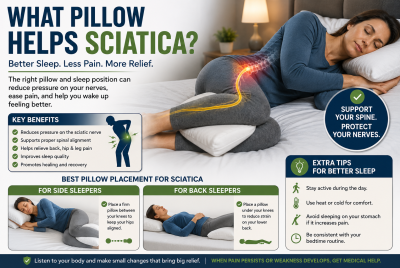
Side sleepers may find a pillow between the knees comfortable. Back sleepers may prefer a pillow or wedge beneath the knees.
The goal isn’t achieving a perfect spinal position.
It’s finding a setup that allows you to sleep without unnecessarily increasing symptoms.
Adequate sleep can also make it easier to stay active, make thoughtful food choices, and maintain consistent health habits.
🛡️ How To Lower Your Risk Of Future Sciatica Flares
You can’t control every factor associated with sciatica, including genetics and normal age-related changes.
You can work on habits that improve your overall resilience.
Consider:
- Stay Regularly Active: Avoid long periods of inactivity.
- Break Up Sitting: Move periodically throughout your day.
- Build Strength: Gradually improve your ability to handle daily physical demands.
- Increase Exercise Slowly: Avoid dramatic jumps in activity.
- Manage Weight When Appropriate: Focus on sustainable changes rather than rapid loss.
- Use Sensible Lifting Habits: Keep manageable loads close and get help with very heavy objects.
- Prioritize Sleep: Recovery supports your ability to remain active.
- Avoid Smoking: Smoking is associated with multiple spinal and general health problems.
Focus on the habits you can control rather than obsessing over a single number on the scale.
🩺 When To See A Doctor Or Chiropractor
If you’re concerned about whether being overweight can cause sciatica because your symptoms are persistent, consider professional evaluation rather than assuming weight is the entire explanation.
Contact a healthcare provider if pain is severe, progressively worsening, repeatedly interferes with daily activities, or isn’t improving with reasonable self-care.
Get prompt medical evaluation for new or worsening leg or foot weakness, significant numbness, difficulty walking, or foot drop.
Seek urgent medical attention for new bowel or bladder control problems, numbness around the groin or saddle region, or severe or rapidly progressing weakness.
If you’re considering chiropractic care, discuss weakness, numbness, previous spinal problems, and other health conditions before treatment. Chiropractic treatment isn’t appropriate for every cause of sciatica.
❓ FAQs About Body Weight And Sciatica
1. Can Being Overweight Cause Sciatica Pain?
Higher body weight is associated with an increased risk of sciatica, but it isn’t necessarily the direct cause. Sciatica usually results from irritation or compression of a spinal nerve root.
2. Will Losing Weight Make Sciatica Go Away?
Not necessarily. Weight loss may reduce some physical demands on the body and improve mobility, but it doesn’t guarantee that nerve compression or sciatica will disappear.
3. Does Belly Fat Put Pressure On The Sciatic Nerve?
Body fat doesn’t normally press directly on the sciatic nerve from outside the spine. However, higher body weight can affect overall mechanical demands and is associated with an increased risk of sciatica.
4. What Exercise Is Best For Overweight People With Sciatica?
There is no single best exercise. Short walks and appropriately progressed strengthening are practical starting points for many people. Exercise should be adjusted if it significantly worsens nerve symptoms.
5. Is Walking Good For Sciatica And Weight Loss?
Walking can support general fitness, mobility, and weight management. Start with comfortable distances and increase gradually rather than forcing yourself through severe pain.
6. Can Obesity Make Sciatica Worse?
Obesity may contribute to greater physical demands and is associated with sciatica risk, but symptom severity varies widely. Weight is only one of many factors that may influence pain and function.
7. How Much Weight Do I Need To Lose To Help Sciatica?
There isn’t a proven amount of weight loss that guarantees sciatica relief. If weight management is appropriate, focus on gradual, sustainable changes and improvements in overall health rather than a specific number solely for treating sciatica.
🌟 Can Being Overweight Cause Sciatica? The Bottom Line
So, can being overweight cause sciatica? Higher body weight can be one contributing risk factor, but sciatica is more complicated than a number on the scale.
Sciatic nerve symptoms usually develop because a nerve root becomes irritated or compressed. Body weight, physical activity, spinal anatomy, age, occupation, genetics, and other factors can all influence your risk.
If weight management would benefit your overall health, approach it gradually.
Walk a little more. Build strength at a comfortable pace. Break up long sitting periods. Choose sustainable eating habits. Prioritize sleep and recovery.
Most importantly, don’t postpone taking care of your back until you’ve lost weight.
You can begin improving your movement, strength, comfort, and confidence today. Small changes repeated consistently are often far more valuable than extreme changes you can’t maintain.
Be patient with your recovery and focus on what your body is gradually becoming capable of doing.
Medical Disclaimer: This article is for general educational and informational purposes only and does not replace professional medical advice, diagnosis, treatment, or individualized weight-management guidance. Sciatica and weight concerns can have many contributing factors. Consult a qualified healthcare professional about persistent or worsening symptoms and before making major changes to your exercise, diet, or supplement routine. Seek urgent medical attention for new bowel or bladder problems, saddle-area numbness, or significant or rapidly worsening weakness.
 Explore more:
- What Happens If Sciatica Is Left Untreated?
- Sciatica Pain After Exercise: Why It Happens?
- Sciatic Nerve Pain Treatment at Home