How Do You Live With Sciatica Pain? A Practical Daily Guide To Sitting, Sleeping, Walking And Working
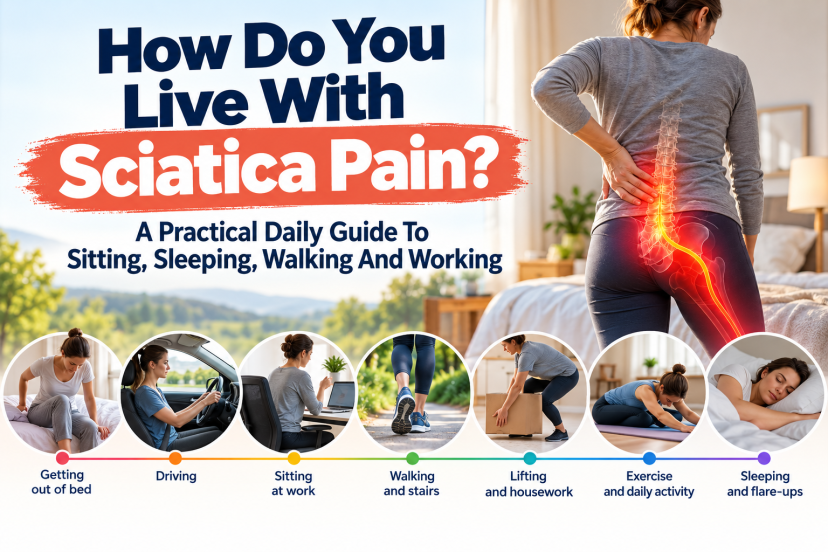
Managing Sciatica From Morning To Night Without Putting Your Life On Hold
Living with sciatica means managing sciatic nerve compression or irritation through practical adjustments to your daily routine. How do you live with sciatica pain? Living with sciatica can make an ordinary day feel surprisingly complicated. You wake up and wonder how to get out of bed without sending pain down your leg. You sit at breakfast and start thinking about the drive to work. Once you arrive, another question appears: How long should I sit before getting up?
Then there are stairs, shopping bags, housework, exercise, the couch, and finally the challenge of finding a comfortable sleeping position.
When you’re dealing with sciatic nerve pain, you can start judging almost every movement by one question: Is this going to make my sciatica worse?
That fear can gradually shrink your daily life. But how do you live with sciatica pain without either ignoring your symptoms or becoming afraid to move?
For many people, the answer is not complete rest. It’s learning how to adjust activities, change positions, pace demanding tasks, stay appropriately active, and recognize the difference between manageable symptoms and changes that deserve medical attention.
The NHS advises people with sciatica to continue normal activities as much as possible, start gentle exercise when able, and avoid sitting or lying down for long periods. Cleveland Clinic similarly notes that extended inactivity can make symptoms worse and recommends returning gradually to physical activity when possible.
The goal, therefore, isn’t to create a perfectly pain-free day. It’s to create a manageable day. Let’s follow one from the moment you wake up until you go back to sleep.
Medical Disclaimer: This article is for general educational and informational purposes only. It is not intended to provide medical advice, diagnosis, or treatment, or to replace care from a qualified healthcare professional.
Quick Answer: How Do You Live With Sciatica Pain?
Living with sciatica usually means finding a balance between staying active and respecting your current limits. Try to avoid spending long uninterrupted periods in one position. Break up sitting with standing or short walks, gradually increase tolerable activity, use sensible lifting techniques, and modify tasks temporarily when necessary. For daily life with sciatica, think in terms of pacing rather than avoidance.
Instead of: I can’t sit.
Ask: How long can I comfortably sit before I should change position?
Instead of: I can’t walk.
Ask: What walking distance can I currently tolerate?
Instead of: I can’t work.
Ask: What adjustments would make work manageable while I’m recovering?
Managing sciatica is often easier when you stop treating movement as simply safe or unsafe and start paying attention to how your symptoms respond over time.
Key Takeaways
Most likely daily challenge: Sciatica can make prolonged sitting, bending, lifting, driving, sleeping, and other ordinary activities uncomfortable because these activities can change the load or position around an already irritated nerve.
Usually serious? Most sciatica is not an emergency, and many cases improve over time, but new or worsening weakness, bowel or bladder problems, or numbness around the saddle/genital area require urgent medical attention.
First thing to check: If you’re wondering how to live with sciatica pain, start by identifying which positions and activities increase or reduce your symptoms and how long you can currently tolerate them.
Best solution: Keep moving within reasonable limits, change positions regularly, pace demanding activities, gradually rebuild your normal routine, and seek medical advice when symptoms are severe, worsening, or failing to improve.
7:00 A.M. — Getting Out Of Bed With Sciatica
Your first challenge may arrive before your feet touch the floor.
After spending hours relatively still, your lower back and leg may feel stiff or sensitive.
Instead of suddenly sitting straight up and twisting toward the floor, slow the movement down.
You may find it easier to:
- Bend your knees slightly,
- Roll toward your side,
- Move your legs toward the edge of the bed,
- Use your arms to help push your upper body upright,
- Pause briefly before standing.
You don’t have to use this exact method if another approach feels more comfortable.
The important principle is to avoid turning getting out of bed into one abrupt combination of bending and twisting when your symptoms are already sensitive.
Once standing, give yourself a moment.
You don’t need to immediately test whether you can touch your toes or perform a deep stretch.
Start your morning gradually.
7:10 A.M. — Dealing With Morning Stiffness
Your first few steps may feel different from how you felt the night before.
That doesn’t necessarily mean your sciatica worsened overnight.
After a long period of inactivity, some people simply need time to get moving.
A gentle walk around the bedroom or house may feel better than remaining in bed waiting for stiffness to disappear.
This fits with general sciatica guidance encouraging people to stay active rather than spending prolonged periods sitting or lying down.
Don’t Make The Morning A Flexibility Test
When you feel stiff, your instinct may be to stretch aggressively.
More isn’t necessarily better.
Sciatica symptoms vary according to their underlying cause, so an exercise or stretch that feels helpful for one person can aggravate another.
Use your symptom response as feedback.
Gentle movement that leaves you feeling the same or better may be reasonable.
A movement that repeatedly sends increasing pain farther down the leg deserves more caution.
7:20 A.M. — Getting Dressed
Getting dressed combines several movements that can be unexpectedly challenging during a flare.
Putting on:
- Socks
- Underwear
- Pants
- Shoes
may require bending forward, balancing on one leg, or pulling your knee toward your chest.
If bending toward the floor increases your symptoms, don’t repeatedly force the same movement every morning.
Sit somewhere stable if that feels better.
Bring your foot toward you rather than repeatedly reaching toward the floor.
A long-handled shoehorn can also reduce unnecessary bending.
The objective isn’t to avoid bending forever.
It’s to make an ordinary task manageable while your symptoms are irritated.
As you recover, you can gradually return to normal movement.
7:40 A.M. — Breakfast And Kitchen Activities
Now you’re making coffee, preparing breakfast, unloading the dishwasher, or packing lunch.
The kitchen contains a surprising amount of bending and reaching.
Think about how many times you:
- Open a low cabinet
- Reach into the refrigerator
- Unload the dishwasher
- Lift a pan
- Bend toward the trash
- Carry dishes
- Stand at a counter
One movement may be fine. Thirty repetitions may not be.
Use The Counter To Your Advantage
Keep frequently used objects within comfortable reach during a painful flare.
You don’t need to reorganize your entire kitchen permanently.
Temporary convenience can help.
If prolonged standing bothers you, prepare part of your meal sitting down.
If sitting bothers you, use food preparation as an opportunity to stand and change position.
This is an important theme in sciatica pain management:
There is rarely one perfect position you need to maintain all day.
Often, changing position is more useful than searching endlessly for the perfect one.
8:15 A.M. — Driving And Commuting With Sciatica
For some people, the commute is one of the hardest parts of the day.
Driving combines prolonged sitting with limited opportunities to change position.
Before starting, adjust your seat so that you can reach the pedals and steering wheel comfortably without excessive reaching or slouching.
Avoid placing yourself so far from the pedals that your affected leg must remain stretched forward.
Equally, don’t move so close that you’re cramped.
The right position is the one that allows you to operate the vehicle safely while remaining reasonably comfortable.
Getting Into The Car
Instead of twisting your torso while stepping one leg into the vehicle, some people find it more comfortable to sit first and then bring their legs inside.
Reverse the sequence when getting out.
Longer Journeys
If a long drive reliably aggravates your symptoms, consider safe breaks where practical.
- Get out.
- Stand.
- Walk briefly.
- Change position.
- Then continue.
Never perform stretches or position changes while driving that interfere with your ability to safely control the vehicle.
If driving is one of your biggest triggers, learn more about driving with sciatica and practical ways to make getting in the car, sitting behind the wheel, and longer journeys more manageable.
9:00 A.M. — Sitting At Work
You arrive at work and face another problem: Eight hours and a chair.
The answer usually isn’t finding a magical office chair that allows you to remain completely still all day.
Even a supportive chair can’t eliminate the effects of prolonged sitting for everyone.
Instead, focus on three things: position, duration, and movement.
Position
Adjust your workstation so you aren’t constantly reaching forward toward your keyboard or screen.
Keep your feet supported comfortably.
If lumbar support feels helpful, use it.
Duration
Suppose you currently notice symptoms after 30 minutes.
Don’t wait until minute 60 when you’re miserable.
Use your current tolerance as a cue to change position sooner.
Movement
Stand up periodically.
Walk to refill your water.
Take a short walk during a break.
Stand during an appropriate phone call.
The NHS specifically recommends avoiding long periods of sitting or lying down when dealing with sciatica.
The objective isn’t to replace eight hours of sitting with eight hours of standing. It’s to break up prolonged positions.
If your job involves long periods at a desk, you may also want to read Can I Work With Sciatica? Practica Ways To Stay Comfortable And Productive for more ideas on adjusting your workday
10:30 A.M. — Standing With Sciatica
Standing can feel wonderful if sitting is your main trigger. For somebody else, prolonged standing may increase symptoms. Again, there is no universal position that every person with sciatica should maintain.
If you use a standing desk, alternate between sitting and standing rather than assuming standing all day must be healthier.
While standing:
- Distribute your weight comfortably
- Avoid repeatedly leaning to one side
- Wear appropriate footwear
- Change position when needed
- Walk briefly rather than remaining completely static
Listen to patterns. If ten minutes of standing feels fine but forty minutes doesn’t, that information helps you manage your day.
11:00 A.M. — Walking With Sciatica
Walking is one of the most useful everyday activities for maintaining movement during recovery, provided you can tolerate it.
But don’t turn walking into a competition.
If you’re recovering from a painful flare, start with a distance or duration that feels manageable.
Maybe that’s five minutes.
Maybe it’s twenty.
The important question is what happens during and afterward.
Watch Your Response
Ask:
- Does pain remain manageable?
- Does it settle after walking?
- Does pain begin traveling farther down the leg?
- Am I limping substantially?
- Do I feel worse for the rest of the day?
You can then adjust your next walk.
For example, two comfortable ten-minute walks may currently suit you better than forcing one painful 30-minute walk.
Gradually build from what your body tolerates.
12:30 P.M. — Using Stairs With Sciatica
Stairs require balance, leg strength, and repeated loading.
During a painful flare, you may find going up or down more uncomfortable than walking on level ground.
Use a handrail when available.
Move at a controlled pace.
Avoid carrying something so large that you can’t see the steps or use the railing.
If one leg feels weak, don’t simply assume that weakness is something you need to exercise through.
New or worsening weakness associated with sciatica deserves medical attention.
Pain may alter how you move temporarily.
Progressive neurological weakness is a different concern.
1:00 P.M. — Lifting Without Unnecessarily Aggravating Sciatica
Sooner or later, daily life requires lifting something.
- A laundry basket.
- A child.
- A grocery bag.
- A box at work.
You don’t need to spend your life refusing to lift anything because you’ve experienced sciatica. But a painful flare isn’t necessarily the best time to test your maximum lifting ability.
When you do lift:
- Keep the object reasonably close to your body
- Avoid combining a heavy lift with rapid twisting
- Use your legs and hips appropriately
- Know when an object is too heavy
- Ask for help when necessary
Mayo Clinic recommends good body mechanics when lifting, including letting the legs do the work, holding loads close to the body, and avoiding simultaneous lifting and twisting.
Think About Repetition Too
One 10-pound object may be easy.
Lifting it 50 times can be a different challenge.
Your total workload matters.
If repeated lifting aggravates your symptoms, temporarily reducing the weight, number of repetitions, or both may help you stay active without repeatedly triggering a major flare.
For a closer look at this everyday challenge, see lifting with sciatica for practical ways to handle objects while your symptoms are still sensitive
2:00 P.M. — Housework Without Turning It Into A Workout
How to do your housework?
- Vacuuming.
- Mopping.
- Laundry.
- Changing sheets.
- Cleaning the bathroom.
- Gardening.
Housework combines many movements that can challenge irritated sciatica.
The biggest mistake may be trying to complete everything at once because you finally have a relatively good day.
Instead of a three-hour cleaning marathon, divide tasks.
For example:
Morning: laundry.
Afternoon: kitchen.
Tomorrow: vacuuming.
This isn’t laziness. It’s pacing.
Be Careful With Repetitive Bending
If repeatedly bending toward a laundry basket aggravates your symptoms, place the basket on a higher stable surface while loading or folding clothes.
When vacuuming, move your whole body rather than keeping your feet fixed while repeatedly twisting your lower back.
You don’t have to move like a robot.
Just make the task less demanding while you’re recovering.
3:00 P.M. — Grocery Shopping And Errands
Shopping can test your progress in several ways.
You may:
- Drive there
- Walk around the store
- Stand in line
- Bend toward shelves
- Push a cart
- Carry bags
- Drive home
- Unload everything
Each individual activity may seem easy.
Together they can add up.
During a flare, smaller shopping trips may be more manageable than one enormous weekly trip.
A shopping cart can sometimes provide convenient support while walking, but don’t rely on it if leaning heavily over the cart changes your posture in a way that increases symptoms.
Carrying Shopping Bags
Balance the load where practical rather than carrying every heavy bag in one hand.
Make two trips if necessary.
Your goal isn’t to prove you can carry all twelve bags from the car simultaneously.
4:30 P.M. — Exercise And Movement
Exercise can feel confusing when you have sciatica.
You’ve probably heard: You need to stay active.
But you may also have discovered that certain movements increase your pain.
Both things can be true.
Staying active doesn’t mean forcing yourself through every exercise.
The appropriate activity depends partly on your symptoms, physical condition, and the cause of your sciatica.
Walking may be enough during an early flare.
Later, your routine might gradually include mobility work, strengthening, cardiovascular activity, or exercises recommended by a physical therapist.
Don’t Judge An Exercise Only While You’re Doing It
Pay attention to what happens afterward.
An exercise might feel fine during the movement but leave your leg significantly worse later.
Conversely, mild temporary discomfort doesn’t necessarily mean you’ve caused damage.
Ask: What happens to my symptoms over the following hours and into the next day?
Your response helps determine whether the activity, intensity, or volume needs adjustment.
If you’re unsure what exercises are appropriate, a physical therapist or other qualified healthcare professional can help tailor movement to your situation.
6:30 P.M. — Sitting On The Couch Or Recliner
You finally get home. Now you want to relax. Unfortunately, your favorite couch may be where your symptoms start complaining again. Soft couches can allow your pelvis and lower back to sink into a position that some people find uncomfortable.
A recliner may feel better for some people because it changes hip and back position, while others find it aggravating. If you regularly use one at home, see Is A Recliner Good For Sciatica? for a closer look at recliner position, support, and why it may feel comfortable for some people but not others.
There is no universal best chair for sciatica. Test your own response.
The Bigger Problem May Be Time
You might spend all day carefully changing position at work and then sit on the couch for three uninterrupted hours.
Your back and leg don’t know that this is “relaxation.”
It’s still prolonged sitting.
During television breaks or between episodes:
- Stand.
- Walk around.
- Get some water.
- Change position.
A few minutes of movement can break up a long evening of sitting.
8:00 P.M. — Why Sciatica May Feel Worse In The Evening
By evening, you may wonder why symptoms have returned when the morning seemed promising.
Look at everything you’ve done:
- You got dressed.
- Drove.
- Worked.
- Sat.
- Stood.
- Walked.
- Used stairs.
- Carried things.
- Shopped.
- Exercised.
- Prepared dinner.
Your symptoms may reflect the accumulated load of the entire day, not one damaging movement.
This is why tracking daily activity can be useful.
If your symptoms consistently increase at approximately the same time every evening, look at what happens during the hours beforehand.
Perhaps your morning routine is manageable, but your afternoon contains too much uninterrupted sitting.
Maybe exercise plus grocery shopping on the same day exceeds your current tolerance.
Or perhaps you feel good in the morning and repeatedly use that opportunity to do too much.
Use Evening Flare-Ups As Information
Don’t automatically treat a flare as failure.
Ask: What could I distribute differently tomorrow?
That question leads to better pacing.
10:00 P.M. — Sleeping With Sciatica
A painful day becomes even more difficult when you can’t sleep.
There is no single sleeping position that works for everyone with sciatica.
Common options people experiment with include:
- Sleeping on the back with support beneath the knees
- Sleeping on the side with a pillow between the knees
- Adjusting pillow thickness and leg position
- Avoiding positions that clearly reproduce leg symptoms
The important point is comfort and support rather than forcing yourself into a supposedly perfect posture.
If you usually sleep on your stomach and it feels comfortable, you don’t necessarily have to change simply because another position is frequently recommended online.
If nighttime is when your symptoms become hardest to manage, read how to sleep with sciatica for more detailed guidance on sleeping positions, pillows, and getting comfortable in bed.
What About The Mattress?
Don’t assume sciatica means you immediately need to buy an expensive new mattress.
If your mattress is extremely worn or clearly contributing to poor sleep, replacing it may be reasonable.
But no mattress can guarantee that sciatic nerve pain will disappear.
Consider the whole picture:
- Mattress support
- Sleeping position
- Pillow arrangement
- Evening activity
- Pain severity
- Overall recovery
Good sleep supports your ability to cope with pain and remain active the following day.
If you’re wondering whether your bed itself could be contributing, see what type of mattress is best for sciatica before assuming that replacing your mattress will solve the problem.
2:30 A.M. — Waking During The Night
You wake because your leg hurts.
Now what? First, don’t assume waking means your condition suddenly worsened.
You may simply have remained in one position for several hours.
Try changing position.
Adjust your pillow.
If appropriate and safe for you, get up briefly and move around before returning to bed.
Keep the environment calm and avoid turning every nighttime awakening into an hour of searching symptoms online.
Look For Patterns
If you wake every night at roughly the same point, consider what may be contributing.
- Is one position consistently uncomfortable?
- Are symptoms already severe before you go to bed?
- Did you dramatically increase activity that day?
Tracking those patterns can help you make practical adjustments.
Persistent sleep disruption is also worth discussing with a healthcare professional, particularly if pain is severe or your symptoms are otherwise worsening.
Planning Tomorrow When You Have Sciatica
A useful daily routine doesn’t mean planning every minute around your back.
It means anticipating the activities most likely to challenge you.
Before bed, think briefly about tomorrow.
Where Will I Be Sitting?
If you have a long meeting, can you change position periodically?
How Much Driving Is Involved?
Would a safe break help during a longer journey?
Am I Combining Too Many Demanding Tasks?
Maybe tomorrow doesn’t need to include the gym, grocery shopping, gardening, and cleaning the entire house.
What Movement Can I Include?
Could you take a short walk during lunch?
What Improved Today?
Don’t focus exclusively on what hurt.
- Maybe you walked farther.
- Sat longer.
- Needed fewer breaks.
- Slept better.
Recovered from a flare more quickly. Those are signs worth noticing.
Creating Your Personal Sciatica Flare-Up Strategy
One of the best things you can develop while managing sciatica is a plan for difficult days.
Without a plan, a sudden increase in pain can trigger panic.
You may stop everything, spend the day in bed, or start experimenting with multiple new treatments at once.
A flare-up strategy gives you a calmer framework.
Step 1: Know Your Common Triggers
Your list might include:
- Prolonged sitting
- Long drives
- Repeated bending
- Heavy lifting
- Unusually long walks
- Intense workouts
- Several demanding activities on the same day
Don’t assume every trigger must be avoided forever.
Knowing your current triggers simply helps you manage exposure while symptoms are sensitive.
Step 2: Know What Usually Helps
Perhaps you respond well to:
- Changing position
- Gentle walking
- Reducing activity temporarily
- Heat or cold
- An exercise recommended by your clinician
- Medication that is appropriate and safe for you
Write down what reliably helps rather than reinventing your strategy every time pain increases.
Step 3: Know Your Current Limits
- How long can you sit?
- How far can you walk?
- How much can you comfortably lift?
- How long can you drive?
These aren’t permanent restrictions. They’re your current baseline.
As recovery progresses, update them.
Step 4: Know Your Warning Signs
Ordinary flare-ups and neurological warning signs shouldn’t be treated the same way.
Seek urgent medical attention if you develop symptoms such as:
- Loss of bladder or bowel control
- Numbness around the genitals, anus, or saddle area
- Severe or rapidly worsening weakness
- Significant symptoms affecting both legs, particularly when associated with neurological changes
These symptoms shouldn’t simply be added to tomorrow’s symptom diary.
They require prompt medical assessment.
Step 5: Track Your Recovery
Memory can exaggerate the importance of today’s pain.
A recovery tracker gives you a wider perspective.
Record:
- Pain level
- Pain location
- Numbness or tingling
- Sitting tolerance
- Walking tolerance
- Sleep
- Activities
- Flare-ups
- Improvements
You may discover that although today was difficult, you’re still doing substantially more than you could three weeks ago. That is why tracking function can be just as useful as tracking pain.
If you’re already using the Sciatica Symptom And Recovery Tracker, continue recording your symptoms as your activity increases. It can help you identify improvements, setbacks, and possible flare-up triggers over the full 30-day period.
Daily Life With Sciatica: Think Adaptation, Not Avoidance
Sciatica can temporarily change how you perform everyday activities.
That’s different from allowing sciatica to permanently control your life.
You may need to:
- Sit for shorter periods
- Walk shorter distances
- Divide housework
- Reduce lifting
- Modify exercise
- Take breaks during long drives, or adjust your sleeping position.
Those changes don’t mean you’ve failed to recover.
They’re tools that can help you remain engaged with normal life while symptoms settle.
As you improve, gradually test your capacity again.
- Sit a little longer.
- Walk a little farther.
- Return to appropriate exercise.
- Resume household activities.
- Increase your work tolerance.
The long-term goal isn’t to construct a life in which your sciatic nerve is never challenged.
It’s to return toward normal activity with confidence.
Frequently Asked Questions
1. Should I Rest All Day If My Sciatica Hurts?
Generally, prolonged bed rest isn’t recommended for uncomplicated sciatica. The NHS advises continuing normal activities as much as possible, starting gentle exercise when able, and avoiding long periods of sitting or lying down. That doesn’t mean ignoring severe pain. You may temporarily reduce demanding activities during a flare, but complete inactivity for extended periods can make returning to normal movement more difficult. Think relative rest, not necessarily total rest.
2. Is Sitting Or Standing Better For Sciatica?
Neither is universally better. Some people find sitting particularly aggravating while standing feels comfortable. Others experience symptoms during prolonged standing. Instead of searching for one position you can maintain all day, alternate positions when possible. If sitting bothers you after 30 minutes, stand or walk before symptoms become severe. If standing for long periods causes discomfort, sit temporarily. Managing sciatica often involves changing positions rather than finding one perfect posture.
3. Can I Still Work With Sciatica Pain?
Many people can continue working or return to work before every symptom has disappeared. The answer depends on the severity of your symptoms and the physical demands of your job.
Temporary adjustments may include:
- Changing positions more frequently
- Modifying lifting tasks
- Reducing particularly demanding duties
- Adjusting your workstation
- Working shorter hours temporarily
- Gradually returning to normal duties
If your job involves heavy physical work or symptoms include significant weakness or neurological changes, professional assessment may be particularly important.
4. What Should I Avoid Doing With Sciatica?
Avoid thinking in terms of a permanent list of forbidden movements. During a flare, it may be sensible to temporarily modify activities that clearly and repeatedly produce significant symptom worsening. That might include prolonged sitting, heavy lifting, repeated bending, or unusually intense exercise. However, permanently avoiding movement because you’re afraid of another flare can also limit recovery and normal function.
Your objective is usually to modify, recover, and gradually reintroduce, rather than avoid normal movement forever. For a more detailed breakdown, see 10 things to avoid doing with sciatica and how to modify them rather than simply becoming afraid of normal movement.
5. How Can I Make Daily Life With Sciatica Easier?
Start by identifying your current tolerances.
Ask:
- How long can I sit comfortably?
- How far can I walk?
- Which household activities are most demanding?
- When during the day are my symptoms worst?
- What tends to trigger a flare?
- What reliably settles one?
Then design your day around sensible position changes and pacing. Break large tasks into smaller ones. Alternate sitting with standing and walking. Gradually increase activity as symptoms improve. Keep a simple symptom and recovery diary if you have difficulty seeing your progress. Most importantly, don’t measure success by whether you experienced zero pain today. Measure whether you are gradually returning to the activities that matter.
The Bottom Line: How Do You Live With Sciatica Pain?
So, how do you live with sciatica pain when ordinary life involves sitting, standing, driving, bending, lifting, working, exercising, and sleeping?
You adapt your day without surrendering it.
- Get out of bed gradually.
- Move when you’re stiff.
- Make dressing easier during painful periods.
- Break up prolonged sitting.
- Change positions at work.
- Walk within your current tolerance.
- Use sensible lifting techniques.
- Divide demanding household tasks.
- Build exercise gradually.
- Don’t spend the entire evening in one position.
- Experiment with comfortable sleeping positions.
And when you have a bad day, look for the lesson rather than immediately assuming you’ve damaged yourself. Managing sciatica isn’t about finding one perfect chair, mattress, exercise, posture, or stretch. It’s about understanding your own symptom patterns and gradually building your capacity for normal life. Some days will be better than others.
A flare-up can happen even while your overall recovery is moving in the right direction.
Instead of asking only: Does my leg hurt today?
Also ask: Am I able to do more than I could last week?
- That may mean sitting for 45 minutes instead of 20.
- Walking around the block instead of only around the house.
- Sleeping most of the night.
- Driving to work.
- Doing your own shopping.
- Returning to exercise.
Those are meaningful signs of progress. Keep moving within reasonable limits, pace activities that currently challenge you, and gradually return to normal routines as your symptoms allow. And if symptoms are worsening rather than improving, particularly if you develop significant weakness, bowel or bladder changes, or numbness around the saddle area, don’t simply change your daily routine. Seek appropriate medical care.
If you’re planning to speak with a healthcare professional, you can also use our Sciatica Doctor Visit Checklist to organize your symptoms, questions, medications, and other important details before your appointment. Together, these free tools can make it easier to spot patterns and give your healthcare professional a clearer picture of what you’ve been experiencing.
Medical Disclaimer: This article is for general educational and informational purposes only and is not intended to diagnose sciatica or provide individualized medical advice, treatment, or exercise recommendations. Speak with a qualified healthcare professional about persistent, severe, worsening, or concerning symptoms.
Explore more:
- Sciatica Symptom & Recovery Tracker
- Sciatica Doctor Visit Checklist
- What Is Sciatic Nerve Pain? A Complete Beginner’s Guide
- What Are The Symptoms Of Sciatica Pain?
- How Long Does Sciatica Nerve Pain Last?
- What Exercises Are Good For Sciatica?
- What Causes Sciatic Nerve Pain?
- How Do I Know If I Have Sciatica?
- How Is Sciatica Diagnosed?
- How Is Sciatica Pain Treated?