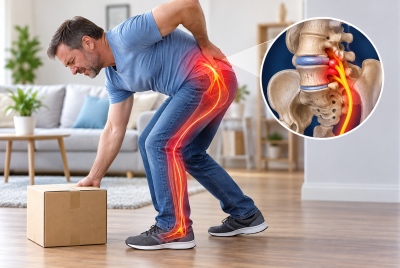
Sciatica Pain When Coughing And Sneezing: Why It Can Send Pain Down Your Leg
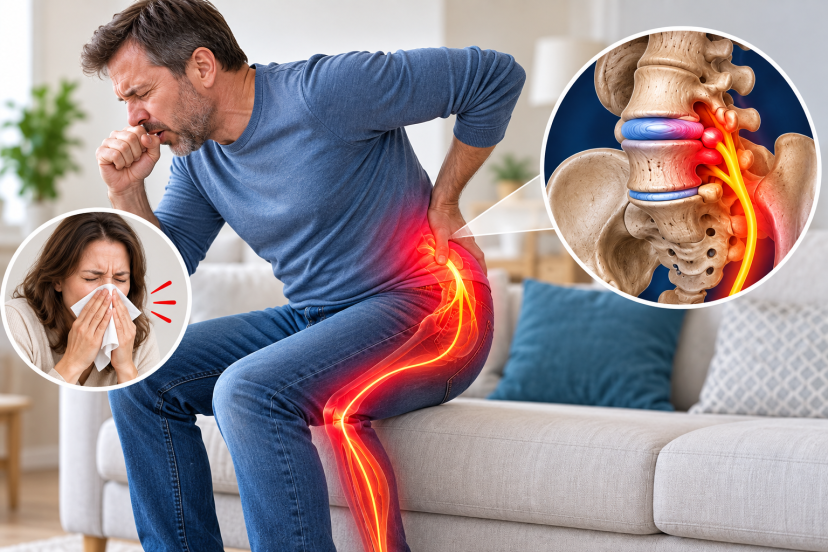
Sciatica Worse When Coughing Or Sneezing
Why Does sciatica pain when coughing and sneezing? A cough or sneeze usually lasts only a second, but when you’re dealing with sciatica, that second can be surprisingly painful.
You may feel relatively comfortable sitting, standing, or walking and then suddenly experience a sharp jolt through your lower back, buttock, or leg when you cough. A powerful sneeze can produce an even more dramatic sensation, sometimes described as an electric shock shooting toward the calf, foot, or toes.
Sciatica pain when coughing and sneezing can occur because these actions briefly increase pressure inside your abdomen and around the spinal canal while your muscles rapidly tighten to stabilize your body. If a spinal nerve root is already irritated or sensitive, that sudden change can make your familiar sciatica symptoms more noticeable.
For some people, the discomfort is confined to the lower back or buttock. For others, it shoots all the way down one leg. Understanding why this happens can make the symptom less mysterious and help you recognize when coughing or sneezing pain is something to discuss with a healthcare professional.
Quick Answer: Why Does Sciatica Hurt When You Cough Or Sneeze?
Coughing and sneezing briefly increase pressure within your abdomen and spinal region. If a nerve root in your lower spine is irritated, compressed, or unusually sensitive, this sudden pressure change may temporarily intensify sciatica symptoms.
You might feel a sharp, shooting, burning, or electric-like pain traveling from the lower back or buttock into the thigh, calf, foot, or toes.
A disc-related problem is one possible cause, but pain with coughing or sneezing alone cannot tell you exactly what is causing your sciatica. Persistent or worsening symptoms, especially those involving significant numbness or weakness, should be medically evaluated.
Key Takeaways
Most likely cause: Sciatica pain when coughing and sneezing may occur when the sudden increase in pressure associated with a cough or sneeze aggravates an already irritated or sensitive spinal nerve root.
Usually serious? Not necessarily. Coughing or sneezing can temporarily intensify sciatica without indicating an emergency, although the overall symptom pattern matters.
First thing to check: Notice where the pain starts, how far it travels down your leg, and whether you also have tingling, numbness, or weakness.
Best solution: Avoid deliberately suppressing normal coughing or sneezing. Instead, use comfortable positioning and discuss persistent or worsening nerve symptoms with a qualified healthcare professional.
What Happens To Your Back When You Cough Or Sneeze?
A sneeze may feel instantaneous, but your body performs a surprisingly coordinated series of actions.
Your respiratory muscles contract forcefully. Your abdominal muscles tighten. Muscles around your trunk help stabilize your body, and pressure within the abdomen and spinal region changes rapidly.
Coughing involves a similar pressure-producing process. For most people, none of this causes pain.
But if you already have an irritated spinal nerve root, the sudden change in pressure and muscular tension may temporarily reproduce or intensify your symptoms.
The effect can be particularly noticeable because coughing and sneezing happen so quickly.
Instead of the gradual discomfort you might experience while sitting for a long time, you may feel a sudden:
- Jolt
- Stab
- Shock
- Burning sensation
- Shooting pain
- Tingling sensation
It can disappear almost immediately or leave the leg feeling irritated afterward.
Why Can Coughing Make Sciatica Worse?
Sciatica isn’t actually a disease by itself. It describes a pattern of symptoms associated with irritation or compression of nerve roots that contribute to the sciatic nerve.
Those nerve roots originate in the lower spine. Several conditions can affect them, and one commonly discussed cause is a lumbar disc problem.
A Herniated Disc May Be One Possible Cause
Between the vertebrae of your spine are discs that provide cushioning and help distribute forces.
When material from a disc bulges or herniates, it can sometimes irritate or compress a nearby nerve root.
Coughing or sneezing can briefly change pressure around the spine. In someone who already has disc-related nerve irritation, that sudden change may make symptoms more noticeable.
This is one reason healthcare professionals may ask whether your leg pain becomes worse when you:
- Cough
- Sneeze
- Strain
However, this symptom alone does not prove that you have a herniated disc.
Sciatica can have several causes, and an accurate diagnosis requires considering your complete symptom history and, when appropriate, a physical examination or additional testing.
Why Does Sneezing Cause Such A Sudden Jolt?
Sneezing is explosive. Unlike slowly bending over or gradually standing up, you have very little control over the speed of the movement.
Your abdominal and trunk muscles contract quickly while pressure changes occur almost instantly. If your nerve is already sensitive, this sudden event may provoke a brief burst of symptoms.
Some people describe it as feeling as though someone “flipped a switch” in their leg.
The pain may begin in the lower back and travel downward, but it can also start in the buttock and shoot directly toward the calf or foot.
Why Can The Pain Travel All The Way Down Your Leg?
This is one of the defining characteristics of sciatica. The irritation may originate around the lower spine, but the symptoms can be experienced much farther away.
Depending on which nerve root is affected, you might notice symptoms in the:
- Lower back
- Buttock
- Hip area
- Back or side of the thigh
- Calf
- Ankle
- Foot
- Toes
For example, you may cough and immediately feel a sharp line of pain traveling from your buttock behind your thigh. Another person may experience almost no back pain but feel an electric sensation extending into the calf or foot. Sciatica also doesn’t always cause pain.
Nerve irritation may produce:
- Tingling
- Pins and needles
- Burning
- Numbness
- Altered sensation
- Weakness
That is why paying attention to the entire symptom pattern is more useful than focusing only on how painful the cough or sneeze feels.
Is Leg Pain When Coughing Always Sciatica?
No. Pain traveling down the leg when coughing can occur with sciatica, but not every episode of leg pain has the same cause.
Muscles, joints, nerves, blood vessels, and other structures can produce leg discomfort.
Similarly, back pain that worsens with coughing doesn’t automatically mean you have sciatica.
Classic sciatica generally involves neurological symptoms following the distribution of a spinal nerve root, often affecting one side.
A healthcare professional can help distinguish sciatica from other possible sources of back or leg pain.
What Does Sciatica Pain From Coughing Or Sneezing Feel Like?
People describe the sensation in different ways.
Shooting Pain
This is perhaps the classic description.
You cough and suddenly feel pain shoot from the buttock down the back or side of the leg.
Electric Shock
Nerve pain can sometimes feel electrical rather than like ordinary muscle soreness.
A sneeze may trigger a very brief but intense “zap” down the leg.
Burning Pain
Instead of a sudden shock, you might notice burning that begins or becomes stronger after coughing.
Tingling
A cough may temporarily increase pins-and-needles sensations in your calf, foot, or toes.
Numbness
Some people with sciatica experience reduced sensation in certain areas of the leg or foot.
Numbness deserves attention, particularly if it is new, spreading, or getting worse.
Weakness
Weakness is different from pain. You may notice difficulty lifting your foot, standing on your toes, climbing stairs, or controlling certain leg movements.
A doctor should evaluate new or worsening weakness.
Why Is Sciatica Sometimes Worse During A Cold?
Having a cold doesn’t necessarily make the underlying cause of sciatica worse. However, frequent coughing and sneezing may repeatedly provoke an already sensitive nerve.
Imagine coughing dozens or even hundreds of times over several days. If every cough triggers a small burst of pain, the symptoms can become extremely frustrating. Being sick may also change your normal routine.
You might spend more time:
- Lying in bed
- Sitting on the couch
- Moving less than usual
- Sleeping in unusual positions
- Bending forward while coughing
Those changes can influence how your back and leg feel as well.
Can Your Position When Sneezing Make A Difference?
Possibly. You can’t eliminate the internal pressure associated with a sneeze, and trying to forcibly suppress a sneeze isn’t a good strategy. But you may notice that certain body positions are more comfortable than others.
For example, if you feel a sneeze coming while standing, some people find it more comfortable to avoid suddenly folding forward at the waist.
If practical, maintaining a reasonably stable position and using a nearby solid surface for support may help you feel more secure.
There isn’t one universally correct sneezing position for everyone with sciatica.
Your goal is simply to avoid adding an abrupt, uncomfortable twisting or bending movement to an already forceful sneeze.
Should You Hold In A Cough Or Sneeze?
Generally, trying to stop every cough or suppress every sneeze isn’t the solution to sciatica. Coughing and sneezing are normal protective reflexes.
If you are coughing frequently because of an illness, allergy, smoking, medication, or another health problem, addressing the reason for the persistent cough with an appropriate healthcare professional may be more useful than repeatedly trying to suppress the reflex.
The sciatica itself should also be evaluated if symptoms are persistent or significant.
Pay Attention To What Happens After The Cough
The duration of the symptom can provide useful information.
Ask yourself:
Does the pain last only a second?
A quick electrical jolt may disappear immediately after the cough or sneeze.
Does the leg continue hurting afterward?
Sometimes the initial jolt settles but leaves the leg feeling irritated for minutes or longer.
Does every cough trigger it?
Consistent reproduction of the same symptom pattern is worth noting.
Is the pain traveling farther down the leg over time?
For example, perhaps symptoms previously stopped at your thigh but now extend into the calf or foot.
Are numbness or weakness appearing?
These neurological changes are particularly important to track and discuss with a healthcare professional.
Track Your Coughing And Sneezing Symptoms
Sciatica symptoms aren’t always consistent. Keeping a simple record can help you identify changes.
Write down:
Trigger: Coughing, sneezing, bending, sitting, walking, or another activity.
Location: Lower back, buttock, thigh, calf, foot, or toes.
Type of symptom: Aching, shooting, burning, tingling, numbness, or weakness.
Duration: Seconds, minutes, or longer.
Intensity: Mild, moderate, or severe.
What happened afterward: Did the symptom disappear immediately, or did your leg remain irritated?
This information can also make it easier to describe your symptoms accurately at a medical appointment.
Learn more: Sciatica Symptom And Recovery Tracker
When Should Sciatica Pain With Coughing Or Sneezing Be Checked?
An occasional increase in familiar sciatica pain during coughing or sneezing isn’t automatically an emergency. However, consider seeking professional evaluation if the symptoms are persistent, severe, worsening, or significantly interfering with daily activities.
You should pay particular attention to neurological changes. Contact a healthcare professional promptly if you develop significant or increasing weakness in the leg or foot or worsening numbness. Certain symptoms require urgent medical evaluation.
These include:
- New loss of bladder control
- New loss of bowel control
- Numbness around the genitals, inner thighs, or saddle area
- Severe or rapidly progressing weakness
- Significant neurological symptoms involving both legs
These symptoms can potentially indicate serious compression of the nerves in the lower spine and should not simply be monitored at home.
Back and leg pain following significant trauma or occurring with fever, unexplained illness, or other concerning symptoms should also be medically evaluated.
Learn more: Sciatica Doctor Visit Checklist
Learn More About The Symptoms Of Sciatica Pain
Pain triggered by coughing or sneezing is only one possible part of the sciatica symptom picture. You may also notice symptoms when sitting, standing, walking, bending forward, climbing stairs, driving, or getting out of bed. And pain isn’t the only symptom.
Sciatica can involve burning, tingling, numbness, altered sensation, and weakness anywhere from the buttock to the toes.
Learn more: What Are The Symptoms Of Sciatica Pain? A Complete Guide To Pain, Tingling, Numbness And Weakness
Understanding your overall symptom pattern can be more useful than focusing on one individual trigger.
Frequently Asked Questions
Why Does Coughing Make My Sciatica Worse?
Coughing causes a brief increase in pressure within the abdomen and around the spinal region while trunk muscles contract. If a spinal nerve root is already irritated or sensitive, this may temporarily intensify sciatica symptoms and cause pain to shoot into the leg.
Why Does Sneezing Send A Sharp Pain Down My Leg?
A sneeze produces a sudden, forceful pressure change. If a nerve root contributing to the sciatic nerve is sensitive, the sneeze may briefly trigger sharp, shooting, burning, or electric-like symptoms along the nerve distribution.
Does Sciatica Pain When Coughing Mean I Have A Herniated Disc?
Not necessarily. A herniated lumbar disc is one possible cause of sciatica, and coughing or sneezing may aggravate disc-related nerve symptoms. However, this symptom alone cannot diagnose a herniated disc. A healthcare professional should consider your complete symptom pattern.
Can Coughing Cause Sciatica?
Coughing itself isn’t usually considered the underlying cause of sciatica. However, coughing can reveal or aggravate symptoms from an already irritated spinal nerve root. Frequent coughing may also repeatedly provoke existing symptoms.
When Should I Worry About Sciatica When Coughing Or Sneezing?
Seek medical advice if symptoms are severe, persistent, worsening, or accompanied by significant numbness or weakness. New bladder or bowel problems, saddle-area numbness, or rapidly progressing neurological symptoms require urgent medical evaluation.
Final Thoughts On Sciatica Pain When Coughing And Sneezing
Sciatica pain when coughing and sneezing can be startling because the pain may appear suddenly and travel a surprising distance down the leg. The reason isn’t necessarily that the cough or sneeze is damaging your sciatic nerve.
Instead, these actions cause rapid changes in pressure and muscular tension. If a spinal nerve root is already irritated or sensitive, that brief change may be enough to trigger a sharp, shooting, burning, or electric-like sensation.
Pay attention to the pattern.
Notice where the pain starts, how far it travels, whether it disappears immediately, and whether you’re also developing tingling, numbness, or weakness.
Those details can help you understand your sciatica symptoms more clearly and give a healthcare professional useful information if you need an evaluation.
Most importantly, don’t ignore meaningful neurological changes. Increasing weakness, significant numbness, bladder or bowel changes, or numbness around the saddle area require appropriate medical attention.
Medical Disclaimer: This article is for general educational and informational purposes only and is not intended to provide medical advice, diagnosis, or treatment. Always consult a qualified healthcare professional regarding symptoms or medical concerns.
Explore more: